Manufacturers face a problem that didn’t exist five years ago. Your competitors are building parts faster, with less waste and more precision than traditional methods allow. Your material costs stay high. Your lead times frustrate customers.
The gap between you and your competitors keeps widening.
Industrial metallic tech innovations are reshaping how manufacturers approach metal production. These aren’t small improvements. There are fundamental shifts in how metal parts get designed, built, and refined.
If you’re still relying on subtractive manufacturing, you’re already behind.
What’s Changing in Metal Manufacturing
For years, traditional metal manufacturing has led the way. You start with a block of material, cut away what you don’t need, and finish the part.
That method works, but it’s slow. It wastes a lot of material. Not to mention it limits what you can design.
New metallic technologies flip this approach. Instead of subtracting, you add. Instead of guessing at parameters, you monitor everything in real time. Instead of accepting variability, you build in precision from the start.
Complex geometries that used to need complicated, expensive machining, now get printed in one step. You can even switch between different metals in a single part.
The best part: there’s a lot less waste.
Near-zero material waste replaces the 70 to 90% scrap rates of traditional machining.
Metal Additive Manufacturing: The Core Innovation
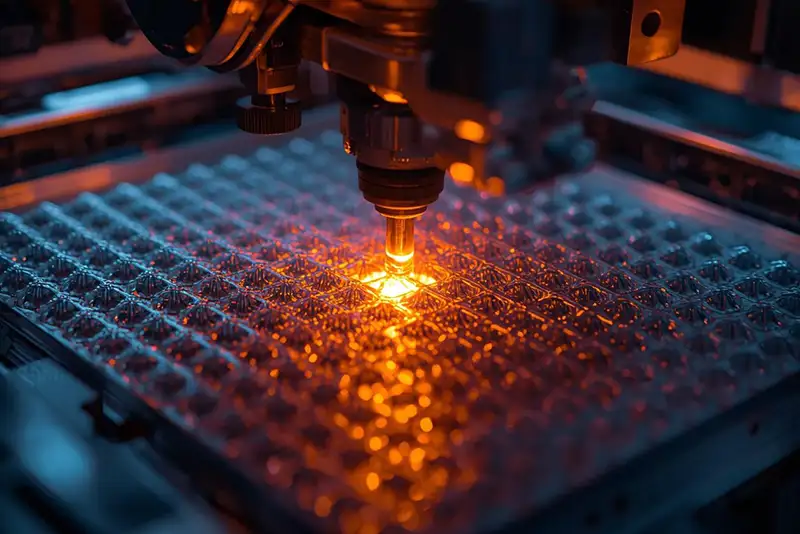
Metal additive manufacturing builds parts one layer at a time. It uses focused energy and metal feedstock. You start with a digital design and end up with a finished part. There’s no need for traditional tooling.
There are a few ways to do this:
- Powder bed fusion melts metal powder with a laser.
- Electron beam melting uses a different kind of energy.
- Directed Energy Deposition, or DED, stands out because it’s both fast and flexible.
At FormAlloy, we use DEDSmart technology. DED melts metal powder or wire with a focused laser and lays it down on a surface. The process repeats, layer by layer, until the part is done. Unlike powder bed fusion, DED handles big parts. It’s great for quick repairs and can switch between materials without a hitch.
Speed makes a difference in manufacturing. DED makes parts two to a hundred times faster than traditional methods. Parts that used to take weeks now get finished in days.
A recent review of Directed Energy Deposition (DED) found that its precise thermal control gives you more design flexibility, boosts production efficiency, and improves quality compared to traditional subtractive methods.
The Intelligence Layer: Real-Time Process Monitoring
Modern metallic innovations make manufacturing smarter.
Optical monitoring systems track the melt pool during deposition, recording video at 55 frames per second. Operators see exactly what’s happening as it happens. More importantly, the system saves everything for review later.
Sensors measure melt pool size and temperature simultaneously. If things start to drift, closed-loop controls adjust the laser power right away.
Advanced inspection systems can now monitor each layer in 3D during a DED build, and they do it fast. A recent study introduced a 360-degree metrology system that rebuilds every layer as it’s added. This real-time monitoring makes it easier to spot defects and keep the process on track with closed-loop control.
Layer-by-layer scanning inspects geometry after each pass. A laser profilometer creates a 3D map of the new layer. If there’s a problem with the shape, the system adjusts the next layer’s parameters to compensate.
The result: consistent quality across parts. What worked on part one works identically on part 100. Variability drops dramatically.
Where Industrial Metallic Tech Innovations Apply
In aerospace, these new methods cut component weight by 30 percent while making parts stronger. Dropping weight means better fuel efficiency.
Defense contractors get precise, reliable components for weapons and armor. Real-time monitoring ensures every part meets strict standards.
Energy companies repair key equipment in days, not weeks, saving time and money. Turbine blades, valve seats, and pump components get repaired instead of discarded.
Medical device manufacturers create implants with the purity and precision patients need.
Car manufacturers build lighter, better-performing parts.
Heavy equipment manufacturers build components that survive harsh conditions: Rock crushers, mining equipment, and industrial machinery experience constant wear. Metallic innovations enable custom repair solutions and performance enhancements.
DED 3D Printing Technology: The Practical Innovation
Directed Energy Deposition technology stands apart because it solves real manufacturing problems.
It repairs valuable parts, like turbine blades, for a fraction of the replacement cost. Designs that once seemed impossible are now buildable.
Material costs drop, especially for pricey alloys. You only use what you need, so there’s almost no waste. For titanium, Inconel, and cobalt-chrome, this translates to thousands in savings per part.
Development moves faster. You can test, tweak, and print new versions in days, not weeks.
DED works with nearly any industrial metal, from titanium and Inconel to stainless steel and copper alloys, and even mixes of materials.
Advanced Metal Fabrication Through Metallic 3D Printing Solutions
Companies using these innovations see real benefits.
- Production time drops. Parts that took six weeks now take just two.
- Inventory shrinks. You keep digital designs and raw materials, then print parts as needed.
- Repair costs fall. Instead of replacing parts, you repair them and save thousands.
- Quality stays high. Monitoring systems ensure every part meets the standard. Forget wastages.
- Designers get more freedom. They focus on performance, not manufacturing limits. The process fits the design, not the other way around.
Industrial 3D Metal Printing: Implementation Challenges
Not every manufacturer is ready for these changes.
- The upfront cost is high. Industrial DED systems run into the hundreds of thousands. It’s a big shift in how you work.
- Getting the process right takes expertise. Each metal and part needs its own setup. Expert help is key.
- Quality standards are strict. Industries like aerospace and medical need certified parts. You can’t just print and go. Validation takes time.
- Adding 3D printing means planning. It’s not about replacing old machines, but adding new tools to work alongside them.
Still, those who invest see big payoffs. Faster production, less waste, more design options, and better products all add up to lasting advantages.
The Role of Software and Intelligence
Raw manufacturing capability matters less than intelligence integrated into the process.
Advanced metallic 3D printing uses software to track every build parameter. Laser power, feed rate, powder flow, temperature, geometry, deviations, and corrections all get recorded. You can repeat successful builds or learn from mistakes. Your process gets better over time.
Some systems offer closed-loop feedback that adjusts parameters in real time. If the melt pool drifts or the shape is off, the machine fixes it right away. This is automated control, made for metal printing.
FormAlloy’s DEDSmart technology is a great example. It monitors and adjusts everything in real time, inspects each layer, and lets you review every build. The system keeps learning and improving.
Why Metallic Tech Innovations Matter Now
More manufacturers are adopting these technologies, as sticking with old methods means falling behind.
Rising material costs and demand for faster delivery make advanced manufacturing even more valuable. Additive approaches can handle complex designs that old methods can’t.
This isn’t a future technology. It’s essential to stay competitive.
Getting Started with Industrial Metallic Tech Innovations
The first step is honest assessment. What are your manufacturing pain points?
Then evaluate whether advanced metallic manufacturing addresses those specific problems. Not every manufacturing challenge requires additive approaches.
If advanced manufacturing fits your needs, start with feasibility testing. Work with experienced partners who understand both the technology and your specific applications.
Parameter development proves the concept works for your materials and designs before you scale production.
Finally, integrate the new capability into your operations. Train your team. Update your design practices. Monitor results and refine your approach.
Ready to Implement Industrial Metallic Tech Innovations
Advanced manufacturing reshapes what’s possible in metal production.
The question isn’t whether metallic innovations work. The question is whether you’ll adopt them before your competitors do.
FormAlloy provides the technology and expertise to implement industrial metallic tech innovations in your operations. From feasibility testing through full-scale production, our team has got you covered.
Contact us today to discuss how metallic innovations apply to your specific operations.
Frequently Asked Questions
Q1: What is metal additive manufacturing?
Metal additive manufacturing makes parts by building them up, layer by layer, with metal. It uses a focused energy source and metal feedstock. Instead of cutting away from a solid block, like traditional machining, it adds material only where it’s needed.
Q2: What metals work with additive manufacturing?
You can use metals like titanium, Inconel, stainless steel, aluminum, cobalt-chrome, and copper alloys. Some hardfacing materials work too. It’s even possible to combine different metals in a single part.
Q3: How much faster is additive manufacturing compared to traditional methods?
Directed Energy Deposition can build parts anywhere from 2 to 100 times faster than regular machining. The exact speed depends on how complex and big the part is.
Q4: What is closed-loop control in metal additive manufacturing?
Closed-loop control means the system watches the process in real time. If something starts to go off track, it automatically changes things like laser power or feed rate to fix the problem. Sensors keep checking and help the machine stay on target.
Q5: Can additive manufacturing repair existing parts?
Yes, it can. DED is great for repairs. It restores damaged parts by adding new metal right where it’s needed. This method is often faster and cheaper than swapping out the whole part.
Q6: What’s the biggest challenge with adopting metallic innovations?
Initial equipment cost and the expertise required for parameter development. Starting with feasibility testing on your specific applications reduces risk.