TL;DR
Metal 3D printing requires total accuracy during every layer of production. FormAlloy uses advanced closed-loop tracking to monitor laser intensity, thermal heat, and material flow in real time. This complete control prevents hidden interior defects and ensures every metal part meets aerospace standards.
How Metal 3D Printing Quality Control Works
Metal 3D printing changes how engineers build critical aerospace parts and heavy machine tools. However, traditional metal fabrication often faces heat warping, microcracks, and internal air bubbles. To stop these hidden failures, modern engineering relies on automated closed-loop systems.
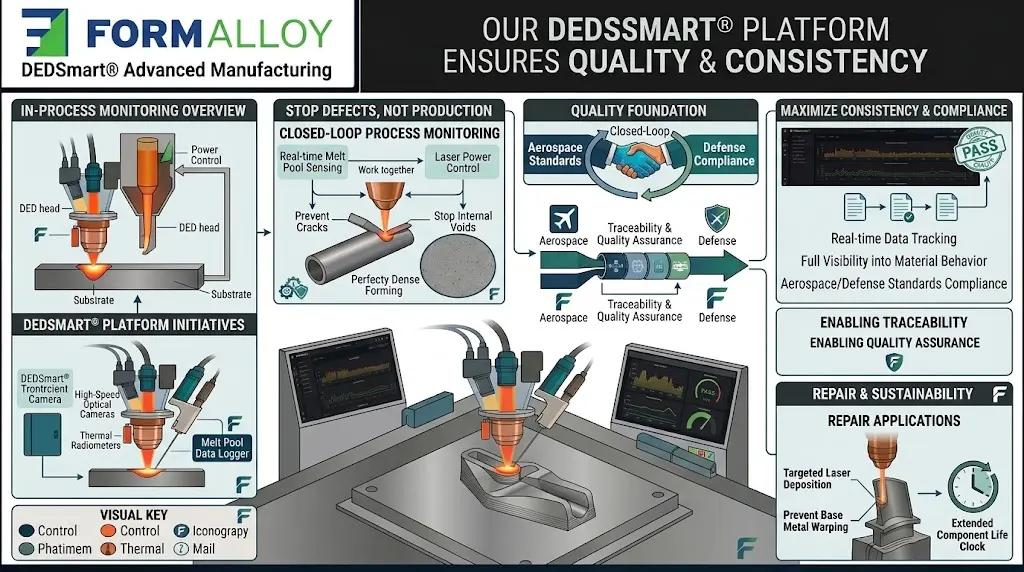
At FormAlloy, we solve these manufacturing challenges with our proprietary platform. Our metal 3d printing technology integrates smart sensor networks directly into the melt pool zone. By continuously adjusting laser intensity and material flow, our systems eliminate process drift before defects occur. Operators maintain full visibility over heat input and material deposition rates throughout the entire cycle. This level of automated control guarantees that every completed build satisfies strict aerospace quality expectations.
Scientific studies published by the National Institutes of Health confirm that real-time thermal monitoring prevents structural defects in laser-directed energy deposition. Research conducted by the National Institute of Standards and Technology also demonstrates that automated feedback loops ensure repeatable density in metal parts.
Real Time Process Monitoring in Metal 3D Printing
Traditional quality assurance checks parts only after production is finished. If a part fails X-ray inspection, the entire component must be scrapped. Real-time sensor tracking fixes this issue by analyzing the metal build as it happens.
Sensors capture high-frequency optical signals, thermal radiation, and melt pool dimensions. When thermal fluctuations occur, the automated system adjusts settings instantly. This dynamic response stops porosity from forming inside the component layers.
| Quality Control Metric | Traditional Inspection | FormAlloy In-Process System |
| Defect Detection | After build completion via CT scan | Instant dynamic optical feedback |
| Thermal Monitoring | Manual spot checks | Continuous real-time heat tracking |
| Material Waste | High risk of full part scrap | Near zero due to instant corrections |
| Process Data | Isolated inspection reports | Complete digital build history |
Our advanced additive manufacturing engineering services deliver verified repeatability for high-stress applications. Operators monitor real-time charts showing melt pool stability, beam power, and powder delivery speeds.
Closed-Loop Melt Pool Stabilization
Melt pool behavior determines the ultimate strength of any 3D-printed metal structure. If the melt pool becomes too large, heat spreads into surrounding zones and causes dimensional drift. Conversely, if the melt pool cools too quickly, unmelted powder particles create structural voids between layers.
To maintain perfect geometry, our systems monitor melt pool size and temperature at high frame rates along the optical path. High-speed cameras capture the thermal signature of the molten metal, while intelligent software adjusts laser power instantly. This dynamic thermal tuning maintains a constant melt volume regardless of component shape or wall thickness. By keeping the thermal footprint stable, manufacturers eliminate micro-cracking and internal stress build-up during long printing cycles.
Layer-by-Layer Optical Profilometry
Surface errors that occur on early layers can accumulate into major geometric defects as a build progresses. Detecting these surface variations early prevents structural compounding and protects downstream tolerances.
Our platform incorporates dynamic laser profilometers that scan the surface geometry of every deposited layer in real time. These sensors generate high-density point clouds to evaluate layer height, track width, and surface flatness before the next pass begins. If an elevation spike or low area is detected, the automated motion control system corrects feed rates and layer heights on the subsequent pass. This automated inspection loop ensures precise dimensional accuracy from the base plate to the top surface.
Metal Powder Control and Cladding Precision
Consistent raw material delivery is vital for solid metal density. Unstable powder flow causes uneven layer thickness, poor bonding, and structural weak spots. Automated powder feeders keep material flow steady throughout long build cycles.
High-grade cladding demands smooth metallurgical bonding without distorting the underlying base metal. By locking in laser energy levels, surface coatings achieve superior wear and corrosion resistance. This exact heat management protects delicate component geometry during complex cladding runs.
Engineers select our custom metal parameter development options to optimize specialized superalloys. Proper calibration prevents thermal stress buildup when depositing Nickel, Cobalt, or Copper alloys.
Advanced Multi-Material and Gradient Alloys
Modern defense and space applications often require components with conflicting material properties, such as extreme heat resistance on one side and high thermal conductivity on the other. Traditional joining methods like welding or brazing create sharp interface boundaries that tend to crack under extreme stress.
Directed energy deposition enables seamless multi-material structures and graded material transitions. By controlling separate powder feeders in real time, our platform dynamically adjusts alloy compositions layer by layer. Process monitoring tracks the melting point shifts of these custom metal blends and adjusts beam intensity accordingly. This capability allows engineers to build single-piece components with customized material properties across different regions without sacrificing structural strength.
Protecting High Value Components
Restoring expensive machine parts requires exact heat management. Excessive laser heat can warp base metals, ruining expensive components beyond repair. Our targeted laser energy repairs damaged sections while keeping surrounding areas cool.
Using real-time optical tracking, our systems scan worn surfaces and deposit metal only where needed. This precise application reduces post-processing work and speeds up repair turnaround times.
Our specialized metal part repair services save original castings from expensive scrap heaps. This reliable approach extends the operational life of heavy turbine components, valve bodies, and flight hardware.
Preventing Porosity and Internal Lack-of-Fusion
Porosity is one of the primary causes of failure in heavy-duty structural metal parts. Gas entrapment and lack-of-fusion voids act as stress concentrators that lead to fatigue failure under cyclic loads.
Our continuous monitoring system continuously evaluates key process indicators to detect conditions that cause void formation. By measuring thermal radiation and spark patterns around the deposit zone, the system identifies gas entrapment risks instantly. Closed-loop controls immediately adjust gas flow rates and laser focus to maintain ideal shielding conditions and complete material fusion. This active mitigation guarantees fully dense deposits that satisfy stringent non-destructive testing requirements.
Full Digital Traceability for Flight Compliance
Aerospace and defense contractors require complete proof of part integrity. Every component needs documented verification covering material purity, laser intensity, and cooling rates.
Our automated software logs thousands of data points every minute during production. These digital logs create an unchangeable record of build parameters from the first layer to the final pass. Quality teams export these comprehensive reports to verify compliance with flight safety regulations.
Discover how our directed energy deposition company builds dependable manufacturing solutions for mission-critical parts. Total process visibility gives prime contractors the confidence to fly 3D-printed components.
Automated Playback for Series Manufacturing
Scaling metal 3D printing from prototype development to high-volume production requires repeatable manufacturing parameters. Small variations in ambient shop temperature or hardware wear can alter print outcomes if process controls remain static.
Our software platform records all critical build metrics during qualified sample runs and saves them as digital process baselines. During production runs, the playback feature matches real-time sensor data against the qualified baseline to maintain identical processing conditions. If parameter drift occurs, the system automatically corrects machine inputs to maintain exact build consistency. This repeatability enables full-scale series manufacturing across multiple machines and production facilities.
Unlocking New Horizons in Manufacturing Excellence
The future of industrial fabrication belongs to systems that self-correct in real time. Combining automated sensor networks, robust hardware, and continuous tracking removes human error from metal printing.
These smart systems allow engineers to build lighter, stronger structures that traditional machining cannot copy. Advanced process monitoring protects projects from unexpected downtime and costly material scrap. Partnering with experienced additive specialists ensures your production meets strict quality demands every single time.
Frequently Asked Questions
How does in-process monitoring stop defects during builds?
High-speed sensors monitor the melt pool size and temperature constantly. The automated platform adjusts laser power immediately to stop cracks and internal voids before they take shape.
What data points do operators track during printing?
Operators track real-time melt pool dimensions, thermal signals, laser power output, powder delivery speed, and chamber oxygen levels continuously.
Why is real-time tracking necessary for aerospace parts?
Aerospace components demand complete structural density and full traceability. In-process tracking generates digital records proving every layer meets flight certification standards.
Can this system repair existing worn metal parts?
Yes, focused heat input allows precise metal deposition on damaged areas without warping the base structure. This dynamic process restores the original geometry cleanly.
How does melt pool tracking boost build consistency?
Melt pool tracking maintains equal heat and material input across every layer. This continuous feedback ensures identical mechanical properties throughout the entire part height.
How does automated control reduce raw material waste?
Catching process errors immediately stops defective builds early. Immediate laser adjustments save expensive superalloy powder from being wasted on failed components.
What metals work with closed-loop deposition?
Closed-loop systems control nickel superalloys, titanium, tool steels, stainless steels, pure copper, and custom multi-material blends effectively.
How does this platform assist quality assurance teams?
The system creates automated digital build reports containing complete process logs. QA teams inspect build data without requiring destructive part testing.
Does in-process tracking speed up production times?
Yes, preventing internal build errors reduces the need for lengthy post-process CT scans and repeated production runs.
Key Takeaways
- Continuous sensor monitoring tracks melt pool behavior and heat input in real time to stop internal defects.
- Dynamic parameter adjustments eliminate material porosity, saving high-value superalloys from scrap.
- Full digital build logging satisfies strict defense and aerospace certification standards.
- Targeted thermal management enables precision component repairs without warping underlying structures.
Ready to Elevate Your Metal Build Quality?
Stop risking expensive material loss on unpredictable production runs. Upgrade your manufacturing pipeline with proven directed energy deposition systems built for accuracy and speed. Contact our team today to validate your custom metal alloys and scale up your production capability.