Industrial metal parts face harsh exposure to friction and wear over time. High-cost equipment often breaks down before its intended operational life ends. Can you repair damaged or worn parts instead of replacing them? Yes, direct energy deposition provides a faster and cleaner way to fix components without waiting for long factory replacement leads. Through precision metal deposition, businesses restore original dimensions and strengthen part surfaces while lowering overall operating expenses.
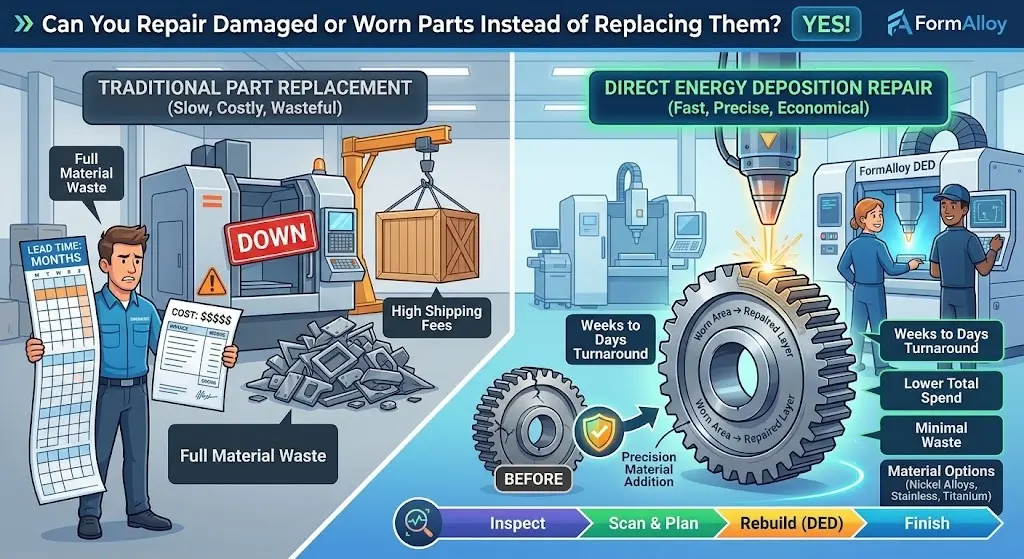
Can You Repair Damaged or Worn Parts Instead of Replacing Them?
When expensive metal parts wear down, throwing them away creates high costs and long production delays. Can you repair damaged or worn parts instead of replacing them? Absolutely, our DEDSmart process deposits raw material directly onto damaged areas with extreme accuracy. The system builds metal geometry layer by layer using a targeted energy beam. This technology helps plants rebuild turbine blades, molds, gears, and tooling in less time. Instead of waiting months for new parts, companies can use metal additive manufacturing services to restore component health quickly.
Metal components in aerospace, energy, and heavy equipment suffer from wear and cracking during everyday operations. Conventional welding often creates uneven heat, which can warp thin metal parts. Direct energy deposition uses controlled heat inputs to keep original part shapes intact. Scientific studies show that laser deposition methods maintain metal structure while creating strong bonds between added materials and base components. You can learn more about metal repair testing through public research from the National Institute of Standards and Technology. Choosing targeted repair helps factories lower waste and return critical machines to work fast.
How Metal Additive Repair Saves Money and Time
Replacing custom metal parts usually means dealing with long lead times and high shipping fees. Manufacturing custom parts from scratch uses large amounts of raw material, and much of it gets turned into waste scrap. Metal additive repair targets only the damaged sections of a part, using only the metal powder or wire needed for the job.
This process saves money on raw materials and machining labor. Keeping original metal cores allows plants to avoid full component remanufacturing. Adding material only where needed shortens turnarounds from weeks to days. Industry reports show that additive repairs lower total maintenance spending while preventing long equipment shutdowns.
The table below highlights the operational differences between full part replacement and laser-based metal repair:
| Repair Feature | Traditional Part Replacement | Direct Energy Deposition Repair |
| Material Usage | Requires full solid block cutting | Uses material on damaged spots only |
| Turnaround Time | Weeks to several months | Days to short weeks |
| Waste Output | High material scrap volume | Minimal waste during processing |
| Thermal Strain | High heat risk from full casting | Low targeted heat exposure |
| Cost Profile | High purchase and delivery fees | Low repair and surface processing cost |
Core Applications for Laser Metal Deposition
Laser metal deposition works across many industrial components. High-wear parts benefit from added protective coatings, while broken edges can be rebuilt to exact specifications.
- Turbine Blades: Restore worn edges and tips exposed to high heat and airflow friction.
- Industrial Molds: Rebuild worn mold cavities and fix chipped surfaces without altering base tool shapes.
- Heavy Duty Gears: Deposit strong alloys onto worn gear teeth to extend service life.
- Tooling Dies: Repairs stamped or cut dies to keep factory lines running smoothly.
Engineers use our advanced metal additive manufacturing systems to coat parts with wear-resistant alloys. These upgrades help components perform longer than the original factory specifications. Further research on repair mechanics is documented by the National Institutes of Health.
Modern Technologies Behind Precise Material Deposition
Modern laser deposition systems rely on real-time monitoring and software control. Systems track melt pool temperatures, beam focus, and powder feeding during builds. Continuous monitoring keeps each added layer uniform and free of internal voids.
Our team uses the DEDSmart technology platform to manage process parameters precisely. Real-time data logging tracks quality standards across every build. Operators can adjust feeds and speeds instantly if thermal conditions shift. This level of control ensures repaired parts meet strict industrial tolerances.
Flexible Material Options for Enhanced Component Life
Metal additive deposition supports a wide range of materials. Operators can choose nickel alloys, stainless steel, tool steels, or titanium based on part requirements. Systems can also deposit bimetallic layers to give parts custom surface properties.
For example, a standard steel part can receive a superalloy outer coating for better corrosion resistance. Combining different metals creates strong parts without the cost of solid exotic alloys. Explore our range of dual powder and wire feedstock systems to see how flexible material choices improve component life.
How Our Process Control Ensures Quality Component Repairs
Process reliability is essential for critical industrial repairs. Automated laser paths map out damaged areas using precise scan data. The system calculates exact deposition lines to ensure strong metal bonds between old and new layers.
Through our application development center services, we test repair parameters before starting work on production parts. This testing confirms bond strength, limits internal stress, and prevents warping. Detailed build reports give teams full traceability for quality control.
Key Steps in the Part Restoration Flow
Every metal repair project follows clear steps to ensure quality results:
- Part Inspection: The damaged component is cleaned, scanned, and checked for deep structural flaws.
- Surface Prep: Worn areas are machined clean to create a smooth surface for new material.
- Deposition Mapping: Software builds an accurate 3D path for the laser tool head.
- Laser Material Deposition: Powder or wire material is fused onto the component layer by layer.
- Final Machining: Rebuilt areas are ground or machined back to exact original dimensions.
Learn more about industrial DED updates through our metal additive manufacturing news. When plant managers ask, “Can you repair damaged or worn parts instead of replacing them?” our team delivers structured results that save both time and overall project budget.
Simple Steps for Repairing Industrial Metal Parts
Restoring damaged metal parts is straightforward when using dedicated additive systems. First, send technical drawings and photos of your damaged part to our engineering team. Next, we evaluate the component and select the right alloy and tool path. Finally, our laser deposition system rebuilds the damaged section with accuracy. Contact our specialists today to plan your repair project.
Frequently Asked Questions
Can damaged or worn metal parts be repaired instead of replaced?
Yes, damaged metal parts can be repaired using direct energy deposition. The process deposits new metal directly onto worn surfaces layer by layer, restoring original geometry and part strength efficiently.
Which industrial parts work best with laser deposition repair?
Turbine blades, molds, heavy-duty gears, and tooling dies work best with laser deposition repair. Any metal component facing heavy wear or surface corrosion can benefit from this targeted restoration process.
How does direct energy deposition rebuild damaged metal geometry?
A focused laser beam melts the substrate surface while feeding metal powder or wire into the melt pool. The system deposits new material along custom tool paths to rebuild missing shapes.
What materials can be deposited onto damaged parts?
Systems handle stainless steels, tool steels, nickel alloys, titanium, and cobalt-chrome. Operators can also apply hardfacing alloys to increase surface resistance against future wear and corrosion.
Is laser additive repair cheaper than buying new replacement parts?
Yes, laser additive repair is usually much cheaper than replacing full components. It saves money on expensive raw materials, eliminates long lead times, and reduces total equipment downtime.
Will heat from laser deposition warp my original component?
No, direct energy deposition uses targeted heat inputs that limit thermal impact. Closed-loop controls protect surrounding metal sections from heat distortion and internal stress.
How long does a typical metal part repair take?
Most laser deposition repairs take just a few days to complete. Turnaround time depends on part size, surface damage, and final machining requirements.
Can laser repair add stronger alloys to weak part surfaces?
Yes, operators can deposit superalloys onto standard metal bases. This process creates bimetallic structures that improve wear resistance beyond original factory levels.
How do I get started with direct energy deposition repair services?
Reach out to our engineering team with your part specifications and damage details. We will analyze your component and recommend a custom material repair process.
Key Takeaways
- Direct energy deposition restores worn parts without requiring full component replacement.
- Targeted material deposition saves raw materials, lowers costs, and reduces overall downtime.
- Precision closed-loop controls protect underlying metal structures from excessive heat.
- A wide variety of alloys can be applied to improve part strength and corrosion resistance.
- Rebuilt components meet strict geometry and performance standards for industrial use.
Reach Out for Custom Part Restoration Guidance
Stop letting worn metal components disrupt your factory production schedules. Contact our engineering specialists today to discover how our direct energy deposition services can restore your parts, extend tool life, and keep your business moving forward.