TL;DR: Yes. FormAlloy’s DEDSmart® X-Series and L-Series systems use PF and ADF powder feeders to blend metal powders during a build, creating bi-metallic and functionally graded parts in a single build. A planned gradient path between alloys reduces the brittle phases that cause cracking at the joint.
Do your systems support multiple materials in a single build? At FormAlloy, the answer is yes. Our DED systems blend two or more metal powders in the same build, shifting the mix layer by layer so the part changes properties where it needs to. For example, one end of a part can be stainless steel and the other end cobalt chrome, with a smooth, engineered gradient between them instead of a rough weld line or a bolted seam.
Think about a jet engine part. One side sits in extreme heat. The other side needs to flex and absorb shock. No single metal handles both jobs well, and two metals welded together can crack at the seam under repeated stress. A graded part addresses this by placing the right property in the right zone.
Why Do Manufacturers Need Multiple Materials in One Part?
Manufacturers used to accept trade-offs. Pick a metal, live with its weaknesses, move on. That approach is losing ground. Rising material costs and tighter performance demands push engineers to ask better questions. Why use an expensive superalloy for an entire part when only a small section touches extreme heat? Why weld dissimilar metals and hope the joint holds?
Functionally graded materials address both problems. A turbine blade design could place a heat resistant nickel alloy at its tip and a lighter, less costly alloy at its base. A valve could carry a hard, corrosion resistant shell over a tough, ductile core. FormAlloy’s X-Series and L-Series machines are built for this kind of work: their PF and ADF powder feeders blend materials to create bi-metallic and gradient structures within a single build.
How Does FormAlloy Print Multiple Materials in a Single Build?
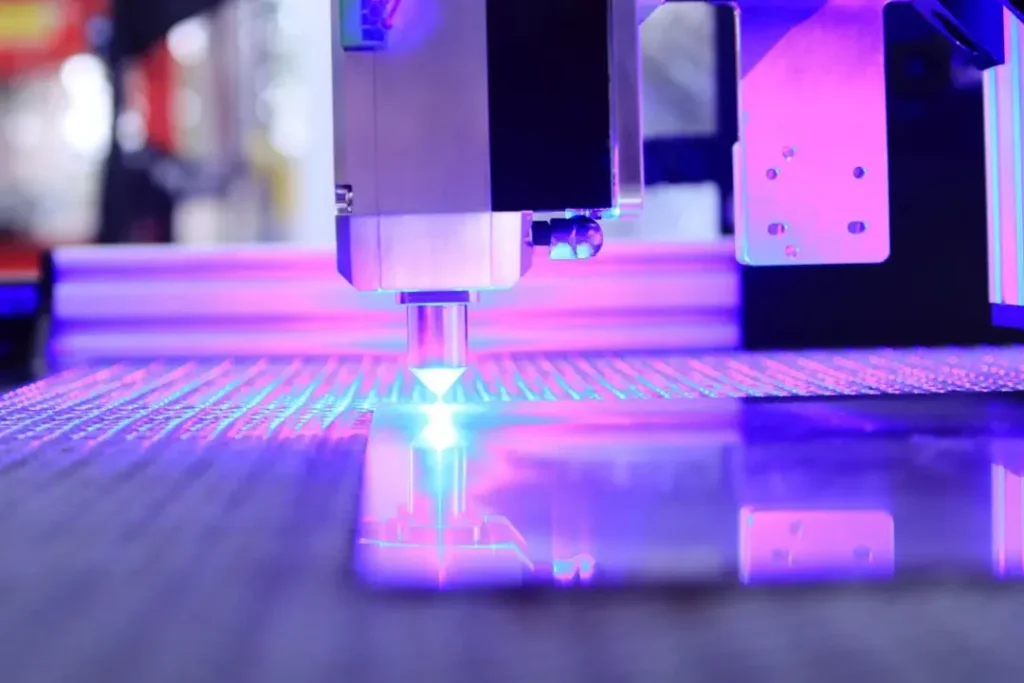
A laser melts a small pool of metal. Powder streams in from separate feeders, and the machine’s software adjusts how much comes from each one as the build moves upward or sideways. Instead of combining materials and hoping for a good result, FormAlloy’s proprietary powder feeders meter the mix in real time.
Independent research has used this capability. A 2023 study published in Scripta Materialia, supported by the National Science Foundation, built functionally graded stainless steels on a FormAlloy L2 DED system by mixing powder blends during deposition, then studied how the changing chromium to nickel ratio shaped the grain structure.
Process control matters because it decides how the metal’s internal structure forms. In early 2026, researchers at Lawrence Livermore National Laboratory in California reported in a modeling study on high entropy alloys that laser scan speed changes how atoms settle into place as the metal cools. Faster scan speeds raise the cooling rate, and faster cooling gives atoms less time to arrange into their usual, sometimes brittle, patterns. FormAlloy’s DEDSmart® systems apply the same idea through closed loop process control: tight control over the process gives tight control over the outcome.
Which Metals Can FormAlloy Combine in One Build?
FormAlloy’s materials list covers nickel, iron, titanium, cobalt, and copper based alloys, plus hardfacing and refractory materials. Common examples include 316L and 17-4PH stainless steel, Inconel® 625 and 718, Ti-6Al-4V, Stellite® 6, GRCop42 copper alloy, and TZM. You can review the full list of metals FormAlloy works with. Not every pair blends directly. Some alloys form brittle compounds when mixed, so the gradient path between them has to be planned before printing.
How Do Planned Gradients Prevent Cracking Between Metals?
Won’t the part fail at the seam where two metals meet? This was a real risk in early multi material printing. When the transition between metals happens too fast, it can form brittle zones that snap under load. A slow, planned gradient is designed to avoid this.
A 2026 study from Lawrence Livermore National Laboratory tackled this exact problem. Researcher J.A. Glerum and colleagues set out to join stainless steel with TZM, a refractory alloy that forms brittle phases when mixed with steel too directly. Using Calphad based modeling of phase behavior, the team planned paths through nickel and chromium interlayers, building a gradual bridge instead of a sharp cliff between the two metals, and validated the designs with builds made by directed energy deposition. The study, published in Additive Manufacturing (Vol. 127, 2026), concluded that gradient path design must account for both phase formation and crack susceptibility. FormAlloy offers parameter development and custom material system services for this planning step.
What Advantages Do Functionally Graded Metal Parts Offer?
Standard parts force compromises. A pump housing made from one alloy either resists corrosion well or handles mechanical stress well, rarely both at full strength. A graded part avoids that trade-off. It changes its properties across its own body, staying hard and wear resistant on the outside while remaining tough and shock absorbing underneath.
Which Industries Use Multi Material DED Parts?
Aerospace teams can use graded parts to handle extreme heat cycles without adding unnecessary weight. Energy companies can use them to protect valves and pipes from corrosion and pressure at the same time. Defense programs can use them to combine toughness with lower overall mass.
FormAlloy’s feasibility testing turns these ideas into tested parts before a customer commits to full production. FormAlloy’s co-founders, Melanie Lang and Jeff Riemann, both began their careers at Boeing, and Lang later spent 14 years at Lockheed Martin, bringing aerospace engineering discipline to the company’s DED work.
Can Smaller Shops Use Multi Material DED Systems?
This technology isn’t limited to rocket parts and turbine blades. Anyone repairing worn industrial equipment, building custom tooling, or manufacturing high value components can use it. FormAlloy’s build sizes range from compact 250 mm R&D systems to large format machines over a meter wide, matching the machine to the job instead of forcing the job to fit the machine.
Frequently Asked Questions About Multi Material Builds
Do FormAlloy systems support multiple materials in a single build?
Yes. FormAlloy’s X-Series and L-Series DED systems use PF and ADF powder feeders to blend metal powders during a build. This lets one part shift from one alloy to another, creating bi-metallic and functionally graded parts in a single build.
What is a functionally graded material?
A functionally graded material is a part whose composition changes gradually from one alloy to another across its body. Each zone gets the property it needs, such as heat resistance or toughness, without a sharp joint between two metals.
Which metals can FormAlloy combine in one build?
FormAlloy’s materials list includes stainless steels such as 316L and 17-4PH, nickel alloys such as Inconel 625 and 718, titanium alloys such as Ti-6Al-4V, cobalt alloys such as Stellite 6, copper alloys such as GRCop42, and refractory materials such as TZM. Whether two specific alloys can be graded together depends on how they behave when mixed, so each pairing is confirmed through feasibility testing.
Does grading two metals weaken the part?
Not when the transition path is planned. An abrupt switch between incompatible alloys can form brittle phases that crack under load. A planned path through compatible intermediate compositions, such as nickel or chromium, is designed to avoid those phases.
How is a graded part different from welding two metals together?
Welding creates a sharp, abrupt boundary between materials. Grading creates a gradual shift, spreading stress across a wider zone instead of concentrating it at one thin line.
Can multi material builds be used for repair work?
Yes. DED can deposit a different alloy onto a worn or damaged area, such as a wear, corrosion, or heat resistant layer over the base metal. FormAlloy uses this approach to repair and enhance existing metal components, not only to build new parts.
Can small manufacturers use multi material DED?
Yes. FormAlloy systems range from a compact 250 mm R&D platform to large format machines over a meter wide, so smaller shops and labs can test alloy blends without a meter scale machine.
How does FormAlloy control quality in a multi material build?
FormAlloy’s DEDSmart® systems use closed loop control and real time melt pool monitoring to adjust the process as each layer is deposited, so quality is checked during the build rather than only after it.
Has independent research used FormAlloy systems for graded metals?
Yes. A 2023 study published in Scripta Materialia, supported by the National Science Foundation, built functionally graded stainless steels on a FormAlloy L2 DED system by mixing powders during deposition.
How can I find out if my part can use multiple materials?
Share your part requirements, target alloys, and operating conditions with FormAlloy. The team uses feasibility testing to check whether a material combination and gradient path will work before production starts.
Key Takeaways
- FormAlloy’s DED systems can blend multiple metal powders within a single build to create functionally graded materials.
- Carefully planned material transitions can help reduce brittle phases and cracking when combining dissimilar metals.
- Precise control of laser and powder feed parameters helps influence the structure and properties of the finished part.
- Functionally graded parts can combine different properties, such as heat resistance, strength, and wear resistance, in different areas of one component.
- Multi material DED can support applications ranging from repairs and custom tooling to aerospace and other high value manufacturing.
Plan Your Next Multi Material Part With FormAlloy
Why should any part settle for one material when its different sections face different jobs? A part that grades from one metal into another isn’t a compromise. It’s a smarter design decision, built layer by layer where strength, heat resistance, or wear protection is needed. Do your systems support multiple materials in a single build? At FormAlloy, that question has real machines, published research, and real parts behind it. Reach out through FormAlloy’s contact page and start a conversation about what a graded part could do for your next project.