In the world of metallic tech, your competitors are already printing larger parts in half the time. Meanwhile, you’re still trying to choose between two technologies. One choice keeps you ahead. The other could leave you stuck with slow production for years.
You can’t afford to fall behind or waste money choosing the wrong machine. That’s where FormAlloy comes in. As leaders in Directed Energy Deposition (DED) technology, we help manufacturers choose the right metal additive manufacturing process for their needs.
Powder Bed Fusion and Directed Energy Deposition are fundamentally different approaches to building metal parts. Understanding the differences isn’t optional anymore. It’s how you stay in the game.
Which one gets your product to market faster? Which one actually fits the size of your parts? Which one makes it through aerospace certification? Those answers could change everything.
Directed Energy Deposition Vs Powder Bed Fusion?
Powder Bed Fusion (PBF) spreads a thin layer of metal powder across a flat surface. Then a laser zaps specific spots, melting them just where you need. The platform drops a bit, another layer of powder goes on, and the whole process repeats—hundreds of times.
It’s super precise, but it’s slow. Making a single part can take weeks.
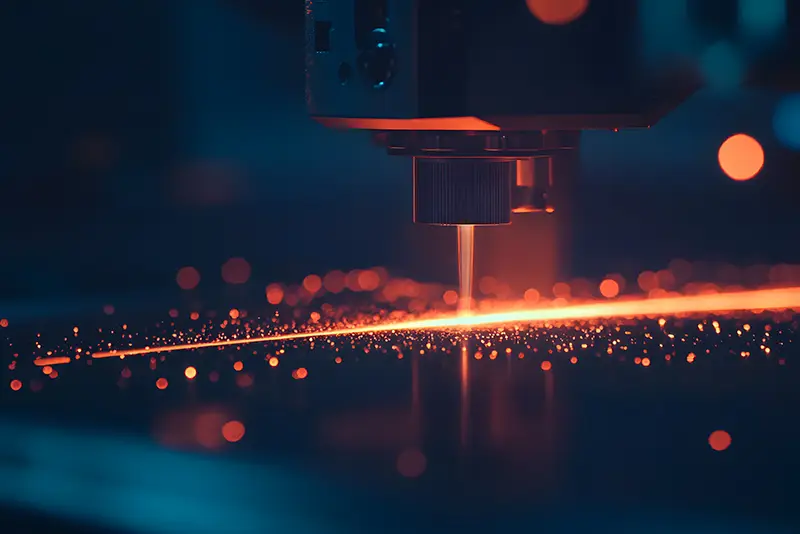
Directed Energy Deposition (DED) takes a different approach. Instead of spreading powder across a bed, it uses a nozzle to feed metal powder or wire right into a focused laser beam. The laser melts the metal on the spot, and the molten metal lands directly on your part. The nozzle moves, laying down more material as it goes.
DED lays down material in a steady flow, while PBF melts powder only where it’s needed. That single difference affects speed, cost, part size, surface finish, and even how much material you waste
Picture PBF like painting a wall with a tiny brush, inch by inch. Now picture DED as pouring paint exactly where you want it. Different tools. Different results.
How Much Faster Is DED For Large Parts?
This is where the numbers get dramatic.
In a benchmark study, researchers compared both technologies on a big rocket nozzle. DED was ten times faster and five times cheaper than PBF. The nozzle stood 200mm tall and had internal cooling channels. Traditional machining wasn’t an option. PBF took weeks. DED got it done in a few days.
Recent cost analysis backs this up. Once your part gets over 500mm in any direction, DED usually leaves PBF in the dust. The bigger your part, the bigger the savings. When you hit 1000mm, DED often costs just a fraction of what PBF would.
DED can handle parts that PBF would have to split into sections. DED is more suitable for larger housings, big subassemblies, or repairs on existing components.
Which Process Produces Better Surfaces?
PBF takes the win here.
PBF gives you smoother surfaces and sharper corners. Those thin powder layers make it possible to capture precise geometric detail. Most of the time, parts need just a little cleanup afterward.
DED, on the other hand, leaves you with rougher surfaces. The bigger droplets of molten metal mean you get coarser features. Most DED parts need some finishing work.
But here’s what matters in practice: if you’re building parts for aerospace, post-processing happens anyway. Tolerances get machined. Surfaces get finished. And because DED can build most of the shape quickly, the finishing work often ends up costing less.
So the real question isn’t which process makes better surfaces as-printed. Which one gets you a finished, ready-to-use part faster? That’s what really counts.
What About Build Envelope And Part Complexity?
PBF systems have fixed build chambers. They’re typically rectangular. Most industrial PBF systems have chambers under 400mm wide and 250mm deep.
Want to print something 600mm long? You physically can’t. You’d split it into two pieces and assemble them. That means more work, more cost, and a higher chance that something goes wrong.
DED systems are a whole different story. They’re mounted on robotic arms or multi-axis platforms, so they can work with almost any part size, as long as you can fit it in the workspace. There’s really no practical size limit. Think ships, aircraft fuselages, or massive tooling—DED can handle parts that PBF can’t.
This is a big deal for aerospace. The industry builds huge things: fuselage sections, wings, big structural pieces. PBF forces designers to split parts artificially. DED lets designers optimize for performance.
Which Technology Wins For Aerospace Applications?
The truth is, aerospace is divided. PBF is ideal for small, detailed parts that need to be spot-on. Think fuel injector nozzles, tricky brackets, or complex assemblies. PBF brings the kind of precision and smooth finish these jobs need.
But when it comes to big structural pieces or repairs, DED takes the lead. A damaged turbine blade worth $200,000 gets repaired with DED in days, not scrapped. Large housing components that’d require extensive machining get printed and finished efficiently.
A study published in The Journal of Materials Research and Technology looked at making Inconel 718 parts with both methods. The researchers found that the two processes actually create different microstructures in the metal. That means the way you make a part changes its properties. You can’t just design a part and expect both methods to give you the same results.
So, what’s the best metal 3D printing process for aerospace? The practical answer: aerospace should use both. PBF for small, complex, precision parts. DED for large structural components and repairs.
What Are The Material Efficiency Differences?
PBF generates material waste in two ways. First, after each layer, the unused powder gets cleared out. Some of it can be recycled, but most of it ends up tossed. Second, the build chamber layout forces spacing around parts to prevent thermal issues. That space becomes wasted powder.
A comprehensive cost analysis found that titanium powder for PBF runs anywhere from $260 to $450 per kilogram. When you’re throwing out extra powder, those costs add up fast.
DED handles material differently. It only puts metal where you actually need it, so there’s hardly any leftover powder. If you use wire feedstock, it’s usually even more efficient than powder.
This matters even more with pricey alloys. Building a big titanium part with PBF can waste thousands of dollars in material. DED minimizes that waste.
How Do You Choose Between DED And Laser Powder Bed Fusion?
Start by asking a few questions about your part.
- Is it larger than 400mm in any dimension? If so, DED is probably your best bet. PBF would force you to split the part into pieces.
- Does it need internal features like cooling channels? Both technologies can handle that. PBF gives you a slight edge in precision, but DED is faster and can save you money.
- Do you need the part finished as-printed? Go with PBF. Its surface finish is good enough that you might not need extra machining.
- Is this a repair situation? DED is the only real option here. PBF can’t easily add new material to an existing part.
- Is cost your biggest concern? For large parts, DED is usually cheaper.
- Is this for a mission-critical aerospace application? You might need both. Use PBF for small, precise subcomponents. Let DED handle the big structures and repairs.
If you want to take advantage of DED in your own shop, FormAlloy’s got you covered. Our DED systems and materials are built for big, complex, high-performance metal parts. Companies in aerospace, energy, and industry trust us to speed up production and keep costs down when the job really matters.
Where The Numbers Point
The global metal additive manufacturing market hit $2.7 billion in 2022. It’s expected to grow by 21.5 percent a year through 2030. Aerospace alone makes up 29 percent of all metal AM applications.
Both technologies are on the rise. But DED is growing even faster for production work outside aerospace. Its cost edge for big parts is pulling in new users from energy, automotive, and industrial companies.
Neither technology is going anywhere. Both are here to stay. The real question is simple: which one solves your problem?
Frequently Asked Questions
Q: What’s the main structural difference between DED and PBF?
PBF melts powder in a bed, picking out spots one by one. DED feeds metal right into a focused laser and lays it down in a steady stream. So, DED is all about continuous deposition, while PBF is more selective.
Q: How much faster is DED for large parts?
Benchmark studies show DED can finish big parts up to ten times faster than PBF.
Q: Why does PBF produce better surfaces?
It’s all about the powder layers. PBF uses thinner layers and melts them very precisely, so you get finer details and smoother surfaces.
Q: Can PBF repair existing parts like DED does?
No. PBF is for new builds only. DED is your go-to for repairs, since it can add material directly to an existing part.
Q: Which technology uses less material overall?
DED is more efficient because it only puts metal where you need it. PBF wastes some powder and needs extra space around each part. Still, both are way better than traditional machining when it comes to saving material.
Q: Is one technology better for aerospace?
It depends on the job. PBF is perfect for detailed, precision parts. DED is better for big structures and repairs. Aerospace companies use both for different reasons.
Q: Which technology is growing faster?
Both are taking off, but in different places. DED is catching on quickly for production manufacturing. PBF is booming in aerospace and medical devices.
Ready To Make The Right Choice
The technology you pick will shape your production speed, costs, and what kinds of parts you can make for years to come. Choose wrong, and you could end up stuck with limits you’ll wish you’d avoided.
At FormAlloy, we focus on DED—perfect for big structural parts, repairs, and scaling up production. If you’re weighing your options or planning a new facility, the key is knowing exactly what your parts need.
Contact us today. Let’s talk about which approach is right for you.