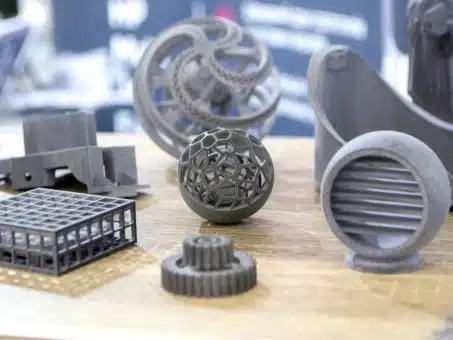
DED in 3D printing isn’t sci-fi anymore. It’s real. It’s here. And it’s already reshaping metal manufacturing. But is it worth the hype?
Let’s be clear: Directed Energy Deposition (DED) is not entry-level. It’s precision tech for pros. Lasers, metal powder, expert control—layer by high-energy layer.
No molds. Minimal waste. Maximum customization. DED offers powerful capabilities—but it demands serious know-how.
So, what is DED really like in the field? Let’s break it down—clearly, accurately, and with respect for what this tech actually delivers.
How Fast Is DED 3D Printing
DED Builds Fast. Very Fast.
DED deposits metal exactly where it’s needed—fast. Sloped surfaces, curved geometries, multi-material zones? Handled.
Ahn’s 2021 study proved it: DED enables aggressive build speeds and geometric flexibility with minimal tooling.
For aerospace and defense, that’s gold. Rapid part production, repairs, and redesigns are all in play.
But speed is only part of the story.
DED Isn’t Plug-and-Play—It’s a Precision Tool.
Let’s correct the myth: DED isn’t “too complex.” It’s specialized.
Setup takes training. Laser parameters, feed rates, and deposition paths must be dialed in with surgical accuracy.
That’s not a downside—it’s a fact of advanced manufacturing. DED rewards expertise and planning. Sloppy prep? Poor parts. Expert execution? Outstanding results.
As Ahn (2021) and others made clear: DED isn’t for the casual user—it’s for those who know what they’re doing.
How Accurate Is DED Metal Printing
DED shines in building intricate geometries and custom alloys. Imran et al. (2024) showed how it meets ISO and ASTM standards with rigor.
But surface finish? Still rough. That’s expected in high-energy deposition. Think “functional finish” out of the box—polishing and post-processing bring the finesse.
Thermal stress, porosity, and flow challenges are real. That’s why advanced players use real-time monitoring, digital twins, and AI tools to control quality.
Bottom line: rough prints aren’t defects—they’re part of a high-performance workflow. The best teams build with that in mind
DED Is Versatile. But Is It Universal?
DED handles functionally graded materials (FGMs), alloy mixing, and hybrid part builds with power and precision.
Strauss et al. (2025) documented up to 40% material savings by using high-cost metals only where needed.
This is what smart manufacturing looks like: performance tailored by layer, function by function.
Resolution? Sure, PBF still leads in micro-detail. But for large, strong, multi-material builds, DED is unmatched
DED Cuts Waste. But Does It Save the Planet?
Less Waste. Big Win.
DED uses only what it needs. That’s a sustainability flex.
Fidan et al. (2024) found that DED cuts waste by up to 80%. That’s a win.
Energy use? Higher than subtractive methods in some cases—but that’s not a flaw. It’s a call to optimize. Smarter paths, tighter controls, and machine learning all help reduce the energy footprint.
DED’s sustainability promise isn’t automatic—it’s engineerable.
How DED 3D Printing Repairs Metal Parts
Fix It Fast
DED isn’t just about new parts—it’s also about saving the old ones.
Pratt & Whitney (RTX) slashed downtime 60% using it for high-stakes aerospace repairs.
But successful repair isn’t just about the laser—it’s about control. Calibration, operator skill, and feedback loops matter. When mastered, the results are game-changing.
DED Is the Future. Or Is It?
Pioneering Innovations
DED isn’t just a trend—it’s evolving.
FormAlloy’s DEDSmart® technology proves it. They combine robotics, lasers, and multi-material builds.
Their systems drive breakthroughs in aerospace, defense, and energy. They also offer smart repairs, custom parts, and fast construction.
FormAlloy isn’t alone. But they’re leading.
Adoption? Still Slow.
Strauss et al. (2025) flagged the hurdles: high startup costs, complex workflows, and skill shortages.
Even if DED is amazing, it’s not effortless. Integration takes time, money, and people.
That’s the real friction slowing mass adoption.
So, Is DED the Metal Savior? Or a Sci-Fi Flop?
Neither. It’s a precision platform that demands expertise—and rewards it.
DED in 3D printing builds fast, repairs smart, minimizes waste, and enables materials you can’t make any other way. But it’s not for amateurs.
Want high performance? Master the process. Want ROI? Partner with the pros.
DED isn’t “easy”—but it’s effective. And it’s already redefining what’s possible.
DED in 3D printing isn’t the future. It’s already here.
Frequently Asked Questions
What does DED stand for in 3D printing?
DED stands for Directed Energy Deposition, a metal additive manufacturing process that deposits material while melting it with focused thermal energy.
Is DED considered metal 3D printing?
Yes. DED is a form of metal 3D printing used to build new geometry, repair existing parts, add features, and apply material to selected areas.
What is the difference between DED and powder bed fusion?
DED feeds powder or wire directly into a melt pool, while powder bed fusion melts selected areas of a powder bed. DED suits larger parts and repairs, while PBF usually provides finer detail.
Does DED use metal powder or wire?
DED can use powder or wire depending on the machine and application. Each feedstock method has different deposition, material handling, and process characteristics.
What metals can be used in DED 3D printing?
DED can process many engineering metals, including stainless steels, titanium alloys, nickel alloys, tool steels, cobalt alloys, and other compatible materials.
Can DED print a complete metal part from scratch?
Yes. DED can produce near net shape metal parts, although machining or finishing may still be required when tight tolerances or smooth surfaces are needed.
Why is DED used for large metal parts?
DED can deposit material at relatively high rates and does not depend on a fixed powder bed, making it useful for larger structures and feature addition. 3D Mag
Does DED 3D printing require post processing?
Often, yes. Machining, heat treatment, surface finishing, or inspection may be required depending on the part, material, and performance requirements.
When should DED not be used for metal 3D printing?
DED may not be the best choice when very fine detail, small internal features, or tight as printed tolerances matter more than deposition rate or repair capability.
How does FormAlloy use DED in metal 3D printing?
FormAlloy uses DED technology for metal part production, repair, material development, feature addition, process monitoring, and advanced manufacturing applications.