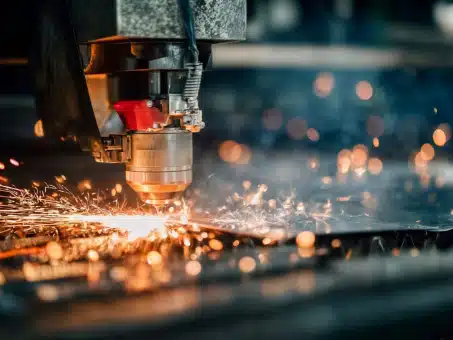
In a busy manufacturing plant, every component plays a crucial role. When a critical metal part wears out or breaks, the entire production line can stop. Every hour of downtime costs the company money, delays orders, and creates stress for managers and workers. Instead of waiting weeks for a replacement part, many companies are turning to laser cladding. This process allows worn components to be repaired quickly and precisely, extending their lifespan and reducing costs.
Laser cladding is more than a repair technique. It strengthens surfaces, improves performance, and minimizes material waste. Traditionally, worn parts were repaired with welding or replaced entirely. Welding adds material but can introduce heat that distorts the component. Replacing parts is expensive and time-consuming.
Laser cladding works differently. A focused laser beam melts and fuses new material directly onto the worn surface, forming a strong, permanent bond. It adds material precisely where it is needed without damaging the rest of the part.
Imagine repairing a scratched metal tool by adding a new layer that becomes part of the tool itself. That is essentially what laser cladding does. It is precise, efficient, and increasingly popular among manufacturers who want to save time and reduce costs.
Why Laser Cladding Is Changing the Way Manufacturers Repair and Protect Parts
When manufacturers faced worn or damaged parts in the past, their options were usually limited to welding or applying a traditional coating. While these methods worked in many cases, they often came with trade‑offs.
Think of traditional welding like patching a bicycle tire with a big, hot iron. It sticks, but the heat can change the tire’s shape, and the patch might not blend smoothly into the original rubber. In manufacturing, welding heats large areas of metal to melt and fuse materials. This can cause parts to warp or weaken because so much heat spreads into the surrounding surface.
In contrast, laser cladding focuses a high‑energy laser beam only where material needs to be added, minimizing unwanted heat and preserving the original part’s shape and strength. This precise control creates a stronger result with fewer side effects than welding.
Precision & Control
One of the big advantages of laser cladding over older methods is the precision and control it offers. Because the laser beam only supplies heat in a very focused area, the surrounding metal stays cool and undisturbed.
This means the part retains its original strength and alignment even after a repair or surface enhancement. As a result, manufacturers can work on complex parts like turbine blades or engine housings with confidence that the component won’t bend or break under stress.
Better Bonding Strength
Better bonding strength is another major benefit. Traditional coatings, like paint or simple plating, often stick mechanically; they cling to the surface but don’t truly become part of it. Laser cladding creates a metallurgical bond, which means the new material actually fuses at a microscopic level with the old material.
This kind of bond is much stronger and far less likely to peel or crack, especially under heavy use. That’s why manufacturers trust laser cladding for critical applications where failure is simply not an option.
Reduced Material Waste
Reduced material waste makes laser cladding not only more efficient but also more sustainable. Traditional coating or welding methods may require thick layers of material that end up being trimmed or ground away later, which creates waste.
Laser cladding only adds material where it’s needed, like putting just the right amount of frosting on a cupcake instead of globbing it all over. This saves on material costs and cuts down waste without sacrificing performance.
In industries like aerospace, automotive, and heavy machinery manufacturing, this combination of precision, strong bonding, and low waste is why laser cladding is becoming the go‑to choice for surface repair and protection, replacing older techniques in many high‑value applications.
Understanding the Laser Cladding Process
Here’s how the laser cladding process works, from start to finish:
Surface Preparation
Before anything else, the metal part that needs repair or enhancement is cleaned and prepared. This is like washing and sanding a piece of wood before painting, so the new layer sticks well. In manufacturing, workers remove rust, oil, and dirt from the surface to create a clean foundation. A clean base allows the new material to bond properly when it’s added later. This step is crucial because any leftover grime can weaken the final result.
Laser Melting
Once the surface is ready, a high‑power laser beam is focused on the part. Think of this as a very intense spotlight that heats metal until it begins to melt just on the surface. This creates a tiny pool of molten metal called a melt pool. Unlike a blowtorch, this laser is precise and only heats the exact area where new material needs to go.
This controlled melting is essential because it ensures the new material will fuse strongly with the old metal instead of just sitting on top.
Material Deposition
Now that you have a melt pool, it’s time to add the new material. The metal to be added usually comes as a fine powder or thin wire that is fed into the melt pool at the same time the laser is heating the surface.
As the laser head moves along the surface, it leaves behind a line of new, fused material. This is like adding icing carefully along the edge of a cake, smoothly and exactly where it’s needed. Because the laser only melts a small area at a time and the material is added where it’s required, waste is reduced, and the final layer is very smooth and consistent.
Controlled Cooling
Once the new material has been deposited, the laser moves on, and the molten metal begins to cool. In the laser cladding process, the molten metal solidifies quickly and evenly because the laser only heats a tiny area, and the rest of the part stays cool.
This rapid, controlled cooling forms a strong metallurgical bond, meaning the new metal becomes one with the old metal at the microscopic level. This bond is much stronger than just sticking something on the surface, the way glue sticks paper together.
A New Lease on Life!
Laser cladding takes worn or under‑performing parts and gives them a new lease on life without having to buy brand new replacements. Instead of throwing a heavy machine part away because its surface has worn thin, manufacturers use laser energy to apply a fresh layer of metal that becomes part of the original component.
This means parts last longer, perform better, and cost less to maintain. The precision and strength of the bond created by laser cladding are two big reasons why so many industries are making the switch from older repair techniques to this advanced method. Today, companies are using it to improve wear resistance, boost corrosion protection, and extend life on everything from mining equipment to aerospace parts.
FormAlloy specializes in advanced laser cladding solutions that make this technology accessible and reliable for real-world industrial applications. By working with FormAlloy, manufacturers can benefit from precision-controlled repairs, stronger metallurgical bonds, and optimized process settings tailored to their parts and materials.
If you want to extend the life of your equipment, improve efficiency, and reduce costs, exploring FormAlloy’s laser cladding services is the next step toward smarter, more sustainable manufacturing.
Contact FormAlloy today and learn more about how laser cladding can transform your operations.
FAQs
Q1: What is laser cladding?
Laser cladding is a process where a laser melts a layer of material onto a worn or damaged part, creating a strong bond that restores its surface and improves durability.
Q2: How does the laser cladding process work?
The process involves four main steps: surface preparation, laser melting, material deposition, and controlled cooling. Each step ensures the new layer fuses perfectly with the original part.
Q3: What industries use laser cladding?
Industries like aerospace, automotive, heavy machinery, and energy use laser cladding to repair critical components and extend equipment life.
Q4: Why is laser cladding better than traditional welding?
Unlike traditional welding, laser cladding focuses heat only where needed, reducing warping and creating a stronger metallurgical bond that lasts longer.
Q5: How to determine laser cladding settings?
Settings depend on material type, laser power, and part geometry. Optimizing these parameters ensures proper bonding, minimal distortion, and a smooth surface finish.
Q6: What are laser cladding services?
Laser cladding services include surface repair, wear protection, and coating enhancements for industrial components, delivered by specialized providers like FormAlloy.
Q7: Can laser cladding improve corrosion resistance?
Yes, adding a new material layer via laser cladding can protect parts from corrosion, wear, and high temperatures, extending service life.