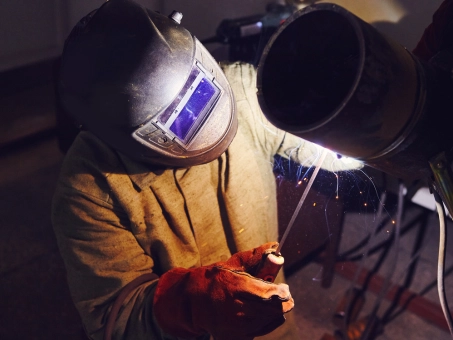
Imagine a machine part cracks. Everything slows down, and you start losing money because the machine can’t work. Waiting for a new part takes a long time, and people will wonder why this problem wasn’t found earlier.
This happens a lot.
One way to fix this is called weld repair. If it is done correctly, it can fix parts fast and save money. If done badly, it can make things worse.
Let us explain weld repair in very simple terms: what usually goes wrong, how experts fix it, and how new laser tools make repairs even better for important parts.
What Is Weld Repair and Why Does It Matter?
Weld repair means fixing a broken metal part, usually where pieces were joined together, and something cracked or wore out. This isn’t just a quick cover-up. If it’s done right, the part becomes strong again, almost like new.
Why is this important?
- New parts cost a lot of money. In industries like airplanes, energy, or defense, one part can cost tens of thousands of dollars. In many cases, this is a more cost-effective option than full replacement.
- Getting new parts takes a long time. Sometimes you have to wait weeks or months.
- Machines that aren’t working lose money every hour they’re down.
So, the real question isn’t if you should repair. It’s how to repair the right way so the part works just like it did before.
Common Weld Defects That Require Repair
Weld damage can look different each time. Before fixing it, you have to know what kind of problem you have.
Here are the most common weld problems:
- Cracks: These are breaks in the metal. Some happen right away, others show up later. Any crack is a big problem, especially in things like airplanes or nuclear power.
- Porosity: These are tiny holes (air bubbles) inside the weld. They make the weld weaker.
- Lack of fusion: This means the melted metal didn’t stick well to the main part. It happens on tricky shapes or sharp angles.
- Undercut: This is a groove or dip along the side of the weld. It reduces the cross-sectional area and creates a stress riser.
- Incomplete penetration: This means the weld didn’t go deep enough. It might look okay on the outside, but inside it’s not strong.
A machine learning–based review published in ScienceDirect found that in industries like aerospace and energy systems, problems in welds can start failures in structures, so finding and fixing them early is very important to avoid serious damage.
Traditional Welding Repair Techniques What Works and What Doesn’t
Traditional welding repair techniques have been used for decades. They work in many situations but fall short in many, too, especially for precision or high-value parts.
Common traditional methods include:
- MIG Welding (GMAW): MIG welding provides fast, efficient metal deposition and is suitable for repairing large or thick components. However, it offers less control when working with small, intricate, or complex geometries.
- TIG Welding (GTAW): TIG welding provides greater precision and control, making it suitable for stainless steel, titanium, and other critical components. The process is slower and typically requires highly skilled operators.
- Stick Welding (SMAW): Stick welding is a versatile and portable repair method that works well for quick field repairs and heavy-duty applications. However, it is less suitable for precision repairs or complex component geometries.
- Laser Cladding: Laser cladding uses a focused laser to deposit new metal onto a damaged surface with controlled heat input. This minimizes distortion and heat-affected areas, making it well suited for aerospace, energy, and other high-value components.
The challenges with conventional methods include:
- High Heat Input: Excessive heat during conventional welding can cause distortion, warping, and residual stress in the repaired component.
- Inconsistent Bonding: Weld quality and bonding can vary, particularly when repairing aged, damaged, or complex-shaped components.
- Limited Material Options: Conventional welding processes may have limitations when repairing advanced alloys, specialty metals, or difficult-to-weld materials.
- Manual Dependency: Repair quality can depend heavily on operator skill, making process consistency more difficult to maintain.
This is exactly why the industry has shifted toward laser-based and DED repair processes for high-value industrial components.
The Laser Weld Repair Process How It Works
The laser weld repair process uses a focused laser beam to melt and deposit metal onto a damaged area precisely. It’s the backbone of modern metal component weld restoration.
Here’s how it works step by step:
- Damage Assessment: The component is scanned to identify the exact location, depth, and extent of the damage.
- Surface Preparation: The damaged area is cleaned and prepared to create a suitable surface for repair.
- Toolpath Generation: Computer-controlled software creates a precise deposition path that defines where and how the new metal will be applied.
- Laser Deposition: A high-powered laser melts the feedstock and deposits new metal onto the component in controlled layers.
- In-Process Monitoring: Sensors and monitoring systems track the repair process in real time to maintain consistent deposition quality and accuracy.
- Post-Processing: Minimal machining or finishing is typically required because the material is deposited with high precision.
A 2024 study by researchers at the Missouri University of Science and Technology and The Boeing Company, published in MDPI Materials, found that pre-heating during laser-directed energy deposition repair significantly reduces residual stress and can help limit distortion under certain conditions. This is important for components like turbine parts that operate under repeated stress.
Weld Defect Repair Methods Choosing the Right Approach
The right weld defect repair method depends on three things: the type of defect, the material, and the operating environment of the part after repair.
Here’s a practical guide:
- Surface Cracks: Remove the damaged material and use laser metal deposition to rebuild the cracked area with new metal.
- Porosity: Re-melt and re-deposit the affected region using controlled laser parameters to restore material integrity.
- Worn Surfaces: Apply laser metal deposition to rebuild worn surfaces with strong, wear-resistant metal.
- Corroded Areas: Restore corroded surfaces using corrosion-resistant cladding materials such as IN625 or 316L stainless steel.
- Complex Geometry Damage: Use multi-axis directed energy deposition (DED) with closed-loop monitoring for precise repairs of complex components.
- Fatigue Damage in the HAZ: Remove the weakened heat-affected zone and rebuild it with new, high-strength metal to restore component performance.
A 2025 study published in Nature Scientific Reports found that laser metal deposition of 304L stainless steel onto 316L components can create defect-free layers with strong bonding, improved hardness (~200 HV), and corrosion resistance similar to the original material, while also reducing material costs.
The key takeaway: the right material paired with the right laser process can restore a part to better-than-original performance in some cases.
Choosing the Right Industrial Weld Repair Partner
Weld repair shops can be very different. Some pay close attention to every detail, while others do not. Careful, skilled work means the repair will last, and a careless job might fail again.
When evaluating a repair provider, ask:
- Do they watch and check the repair as they work, not just at the end?
- Can they fix parts made from special metals like Inconel, Stellite, Titanium, or pure Copper?
- Do they have smart systems that fix mistakes right away while repairing?
- Can they repair parts that need more than one kind of metal?
- Do they give you clear records showing exactly how the repair was done?
This is where FormAlloy’s DEDSmart® repair services stand apart. Our DED systems use real-time optical melt pool monitoring, closed-loop laser power control, and layer-by-layer geometric scanning, making sure each layer is strong and fully attached, from the first layer to the last. We control the laser and check every layer to ensure each layer is consistently bonded and of high quality throughout the build.
At FormAlloy, we can work with many types of metals, including advanced alloys such as NASA-developed materials like GRX-810. Most regular repair shops are not equipped to handle these materials. If you want to know all the materials we can handle, visit our Manufacturing Solutions page.
Metal Component Weld Restoration: When Repair Beats Replacement
Many people think you always need to replace a damaged part. But in many cases, fixing it can be more cost-effective than full replacement.
Repair makes the most sense when:
- Only a small area is damaged, like a crack or a worn spot.
- The main part is still strong.
- Getting a new part takes a long time or costs a lot.
- The part has a complicated shape that’s hard to make new.
- You want the machine running again quickly.
Replacement makes more sense when:
- The whole part is damaged.
- The base material is fatigued or compromised at a structural level.
- Multiple repair cycles have already been done.
For the most important and expensive parts, like turbine blades or special machine parts, weld repair with DED is often one of the most effective options.
The Right Repair Restores Performance
Weld repair is a careful, high-quality process. With the right technology, close monitoring, and the best materials, a repaired part can even work better than the original.
What matters is not just finding someone who knows how to rebuild parts with full control, smart tracking, and the right metal for your needs.
At FormAlloy, our DEDSmart® technology does exactly that. Our team has the tools, experience, and data to fix your most important parts. If you have a repair problem, contact us to discuss your repair challenge and find out what’s actually possible.