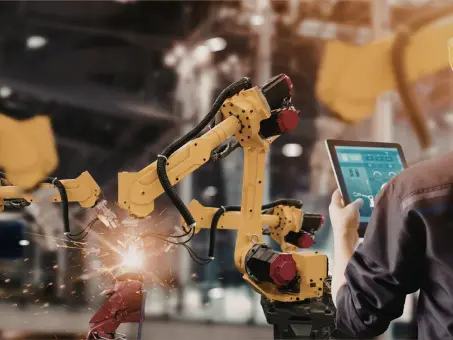
A few years ago, a small manufacturing shop struggled to keep up with demand because every weld depended on human speed and consistency. Some days, the results were perfect. Other days, tiny variations led to defects and delays. This is where robotic welding started to change the game. Today, robotic welding allows machines to perform the same weld over and over with near-perfect accuracy, helping teams produce more parts without sacrificing quality.
Think of robotic welding like a highly trained worker that never gets tired. It follows precise instructions using sensors and programmed paths, which means fewer mistakes and stronger welds. According to the International Federation of Robotics, industrial robot adoption has continued to grow globally since 2022, especially in manufacturing sectors that rely on consistency and speed.
Even companies that once relied fully on manual labor are now blending human skill with robotic welding to get the best of both worlds. The result is faster production, safer workplaces, and products that meet strict quality standards every single time.
Why Is Robotic Welding Becoming Important in Manufacturing?
Walk into a modern factory today, and you will notice something different. Instead of rows of workers repeating the same weld all day, you might see robotic arms moving with smooth, precise motions. This shift is happening because robotic welding solves a problem that has challenged manufacturers for decades: inconsistency.
Imagine two workers welding the same metal joint. Even if both are skilled, small differences in hand movement, timing, or fatigue can lead to slightly different results. Over hundreds or thousands of parts, those small differences add up. Robotic welding removes that guesswork. It follows the same path every time, which means every weld looks and performs the same.
This consistency is a big reason why industries like automotive and aerospace are rapidly adopting robotic welding systems.
Speed is another major factor. A robot does not need breaks, does not get tired, and can work continuously with minimal supervision. That means automated welding solutions can complete tasks faster than manual processes, especially in high-volume environments. At the same time, these systems improve safety by keeping workers away from heat, fumes, and sparks.
There is also a growing need for precision, especially in advanced sectors using industrial robotic welding applications like additive manufacturing. According to research from McKinsey & Company published after 2022, manufacturers adopting automation technologies are seeing measurable improvements in product quality and operational efficiency.
To put it simply, robotic welding is essential because it helps manufacturers do three things better: make products faster, make them safer, and make them the same every single time.
How Much Do Robotic Welding Systems Cost?
When a mid-sized manufacturing company first considers robotic welding, the price tag can feel overwhelming. One shop owner once compared it to buying a high-end machine for the first time. It looks expensive upfront, but the real question is what it saves you over time. That is exactly how robotic welding works.
The initial cost of robotic welding systems usually includes the robot itself, software, setup, and training. For many businesses, this can range from tens of thousands to a few hundred thousand dollars, depending on complexity. But here is where the story shifts. Instead of looking at cost alone, manufacturers are starting to look at return on investment.
Take labor, for example. Skilled welders are in high demand globally, and shortages have been widely reported. According to the American Welding Society, the welding industry continues to face a significant workforce gap through the mid 2020s. This means companies often spend more on hiring, overtime, and training. With robotic welding, one operator can oversee multiple systems, reducing long-term labor costs while keeping production steady.
Material waste is another hidden expense. In manual welding, small mistakes can lead to rework or scrapped parts. Over time, this adds up. Automated welding solutions reduce these errors by following precise, repeatable paths. Think of it like baking with a perfectly measured recipe every single time instead of guessing ingredients. The result is fewer wasted materials and more usable products.
There is also the cost of downtime. In traditional setups, production may pause due to fatigue, shift changes, or human error. Robotic welding systems can run longer hours with consistent output, which increases overall productivity. According to insights published after 2022 by Deloitte, manufacturers adopting automation technologies are seeing improved efficiency and reduced operational disruptions.
Another important factor is scalability. As demand grows, companies using welding automation for manufacturing small batch production can quickly adjust without needing to hire and train large teams. This flexibility allows businesses to take on more work without dramatically increasing costs.
While robotic welding may seem expensive at the start, it often pays for itself by saving money in labor, reducing waste, and improving efficiency. For manufacturers thinking long term, it is less about the upfront price and more about the value it delivers over time.
FAQs
How Robotic Welding Supports Advanced Manufacturing
At FormAlloy, we don’t just talk about robotic welding. We help you make it work in the real world. From advanced industrial robotic welding applications to flexible automated welding solutions, we design systems that improve precision, reduce waste, and scale with your needs.
We understand that adopting robotic welding can feel like a big step, especially when cost, integration, and performance are all on the line. That is why we work closely with your team to simplify the transition and deliver measurable results. If you are ready to improve efficiency, quality, and long-term ROI with welding automation for manufacturing, let’s start the conversation.
Talk to our team today to see how FormAlloy can transform your production.