TL;DR
DEDSmart® technology is FormAlloy’s patented directed energy deposition system that prints and repairs metal components up to 100 times faster than conventional methods. It uses real-time melt pool monitoring and dynamic laser adjustment to deposit metal powder or wire with incredible precision. This complete guide explains how this advanced system eliminates structural defects, reduces material waste, and modernizes industrial production.
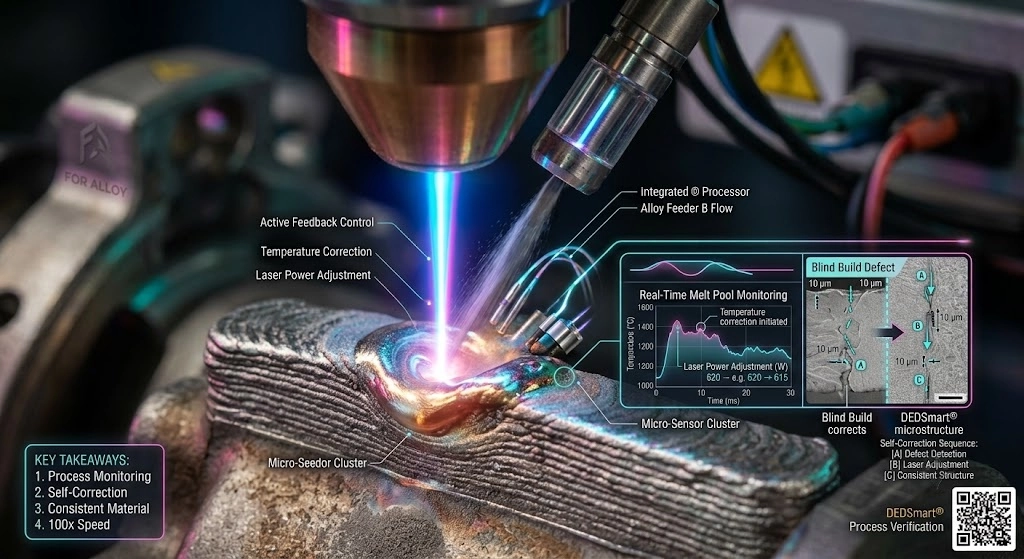
DEDSmart® technology solves this problem by combining high-speed Directed Energy Deposition (DED) with automated closed-loop controls. The system feeds metal powder or wire directly into a focused laser beam, melting the material into a precise metallurgical bond on contact.
Unlike older additive tools that build blindly, this closed-loop platform measures temperature and melt pool geometry during the print. It adjusts laser power and feed rates instantly, stopping defects before they form. Federal research at the National Institute of Standards and Technology Directed Energy Deposition shows that active process control during thermal deposition dramatically improves layer uniformity and material density. This ability to build, repair, and coat parts in a single setup makes DEDSmart® technology a major leap forward for global manufacturing.
What Is DEDSmart® Technology and How Does It Work?
Traditional metal printing takes place inside closed powder beds. That setup limits your part size and slows down deposition speeds. DEDSmart® technology works differently. It mounts a focused energy head onto a multi-axis robotic arm or CNC gantry. The head shoots a concentrated laser while blowing fine metal powder or feeding solid wire directly into the focal point.
The system builds or repairs parts layer by layer in open space. You do not need to fill a massive chamber with expensive powder just to make a small component. The real magic happens inside the smart optical sensor package. Built-in thermal cameras scan the active melt pool hundreds of times per second. If the metal gets too hot or too cool, the system corrects the power level automatically. This active feedback keeps microstructures consistent throughout the entire build.
Why Is Smart Monitoring Better Than Standard Manufacturing?
Standard machining strips away excess metal from a raw block. That process wastes up to 90 percent of your raw stock material. Early 3D printers saved material, but they lacked feedback controls. That limitation caused hidden internal cracks, high porosity, and unexpected batch failures.
DEDSmart® technology removes the guesswork from metal fabrication. It delivers high deposition rates while maintaining low porosity. You can check our detailed FormAlloy Equipment Guide to see how custom machine setups handle complex builds. Studies on NASA Liquid Rocket Engine Components Additive Manufacturing confirm that real-time process monitoring during laser deposition prevents internal thermal cracking in high-stress alloys.
| Feature Comparison | Traditional Metal Machining | Basic Powder Bed Printing | DEDSmart® Technology |
| Deposition Speed | Very Slow (Subtractive) | 1x Baseline | 2x to 100x Faster |
| Material Utilization | 10% to 30% Effective | 60% to 70% Effective | Up to 95% Effective |
| Quality Control | Post-Process Testing Only | Post-Process Inspection | Real-Time Closed-Loop Feedback |
| Component Repair Capability | Extremely Limited / Impossible | Not Supported | Fully Integrated Repair & Cladding |
| Multi-Material Printing | No | No | Yes (Graded Alloy Deposition) |
How Can Industries Use This System for Component Repair?
Industrial machine parts wear down over time due to heat, friction, and harsh chemical environments. Replacing huge turbines, shafts, or valves costs millions in equipment and lost production time. DEDSmart® technology gives worn components a second life by depositing new material directly onto damaged areas.
First, 3D laser scanners map the worn or broken section of the part. Next, the automated toolhead deposits matching alloy layers to restore original dimensions with strong metallurgical bonds. Review our specialized FormAlloy Wear Resistant Coatings page to explore how protective surface treatments double component lifespan.
Key industrial applications include:
- Aerospace Propulsion: Rebuilding worn turbine blade edges and rocket nozzle liners with heat-resistant superalloys like Inconel 718.
- Energy Sector Support: Restoring worn valve seats, pump impellers, and drill bits used in harsh offshore setups.
- Automotive Tooling: Fixing cracked stamping dies and injection molds right on the shop floor to keep lines running.
- Custom Alloy Creation: Blending copper and nickel alloys dynamically to form custom gradient structures with high thermal conductivity.
You can check out our FormAlloy Multi Material Solutions to discover how dual-powder feeders combine different metals into single seamless parts.
What Key Steps Ensure Successful System Integration?
Switching to automated direct energy deposition requires a clear execution plan. Combining advanced hardware, intelligent software, and proper alloy selection guarantees high ROI from day one.
1. Evaluate Geometry and Material Needs
Select parts that require fast production, heavy material removal, or specialized surface cladding. Match these needs with appropriate alloys like titanium, stainless steel, or tool steel. Read our detailed FormAlloy Aerospace Applications guide to learn how high-temp alloys perform under dynamic loads.
2. Program Toolpaths and Closed-Loop Parametrics
Convert 3D CAD files into precise multi-axis toolpaths. Set baseline laser power, powder feed rates, and gas flow rates. Enable automated melt-pool sensing to keep temperature profiles steady across every layer.
3. Deposit and Perform Post-Processing
Deposit high-density metal rapidly onto your base substrate. Finish parts with minimal light machining or stress-relief heat treatment to meet exact final tolerances. Check out our FormAlloy Metal Powder Feeder Options to see how consistent media delivery optimizes final density.
Frequently Asked Questions
What makes DEDSmart® technology different from typical 3D printing?
Typical 3D printing melts powder layers slowly inside a sealed box. DEDSmart® technology blows powder directly into a laser beam on multi-axis arms, depositing metal up to 100x faster while monitoring quality live.
Can this platform blend multiple metals during a single print?
Yes. The multi-feeder hardware injects different alloy powders into the melt pool simultaneously. This lets operators adjust material composition across a single component to improve heat resistance or surface hardness.
What types of metals can the system process?
The platform handles reactive and refractory metals easily. Common materials include Inconel 625, Inconel 718, Ti-6Al-4V titanium, cobalt-chrome, copper alloys, stainless steel, and tool steel alloys.
How does real-time monitoring stop part failure during printing?
Optical thermal sensors scan the melt pool constantly. If thermal imaging detects hot spots or cool dips, the software adjusts laser output instantly to prevent void formation, warping, and micro-cracking.
Is this system suitable for repairing expensive old parts?
Yes. The machine deposits fresh alloy directly onto worn, cracked, or corroded sections. It creates strong metallurgical bonds with low heat input, preventing base metal distortion during restoration.
How fast can this hardware deposit metal compared to powder bed systems?
The system deposits several pounds of metal per hour depending on laser power and nozzle style. This setup builds large parts two to one hundred times faster than standard powder bed units.
Does direct energy deposition lower raw material waste?
Yes. Subtractive CNC machining carves away massive amounts of metal stock. Direct deposition puts material only where needed, reducing raw stock waste by up to 90 percent on complex parts.
What post-processing steps do printed parts need?
Because the process deposits metal near net-shape, components need minimal post-processing. Most parts require light surface CNC milling on mating faces or standard heat treatment for stress relief.
How does closed-loop control improve part repeatability?
Closed-loop control tracks deposition conditions continuously. It compensates for heat buildup across long print jobs, guaranteeing consistent grain structures and mechanical performance from part to part.
Key Takeaways
- Unmatched Production Speeds: Deposits high-density metal up to 100 times faster than old-school powder bed systems.
- Active Quality Monitoring: Thermal sensors track the melt pool in real time, stopping structural defects as they form.
- Cost-Effective Repairs: Restores damaged or worn industrial components directly, saving millions in replacement expenses.
- Multi-Material Capability: Combines different alloys within a single component to maximize heat, corrosion, and wear resistance.
- Drastic Waste Reduction: Places metal only where needed, cutting raw material scrap rates dramatically.
Transform Your Production Floor with Modern Metal Solutions
Slow build times and high scrap costs should not hold back your manufacturing goals. DEDSmart® technology delivers the speed, precision, and closed-loop control needed to build superior metal components with confidence. Whether you need to repair high-value components, apply wear-resistant surface coatings, or produce complex multi-material parts, our advanced additive systems help you manufacture smarter. Contact the engineering team at FormAlloy today to schedule a custom demonstration and discover how direct energy deposition elevates your capabilities.