Laser metal deposition services use a focused laser beam and metal powder to build, coat, or repair metal parts with precision no welding process can match. FormAlloy’s directed energy deposition (DED) platform handles everything from new-part production to worn-component restoration. This article explains how it works, what it fixes, and why it matters for your operation.
What Are Laser Metal Deposition Services
A laser melts metal powder. The powder fuses to the surface. Layer by layer, a part takes shape or a worn area gets rebuilt.
Laser metal deposition services solve problems traditional manufacturing cannot. A cracked die does not have to be scrapped. A worn shaft does not have to be replaced. A geometry that cannot be built in days.
This process works for three things:
- Building new metal parts from a CAD file
- Repairing worn or damaged components
- Applying protective coatings to existing surfaces
NIST’s Additive Manufacturing Research Center studies this process directly. Their work shows how laser power, powder flow rate, and standoff distance all affect the quality of the deposited material. You can review their DED research at the NIST Directed Energy Deposition page.
NASA has also confirmed that laser metal additive manufacturing using DED is actively changing how aerospace parts are built and repaired (NASA NTRS, 2021). FormAlloy’s own Laser Powder DED systems are cited directly in NASA research as an example of this technology in action.
The FormAlloy manufacturing solutions page shows the full scope of what these systems produce.
Why Metal Teams Turn to Laser Cladding Services for Repair
Replacing a high-value part is expensive. Lead times for new forgings or castings stretch for weeks. Scrap costs add up fast.
Laser cladding services offer a smarter option. Instead of scrapping a worn turbine blade, pump shaft, or die, a laser deposits new material directly onto the damaged area. The deposited layer bonds metallurgically to the base part. It does not sit on top like paint. It becomes part of the component.
Here is what that means in practice:
- The repaired zone has the same density as the original material
- There is no delamination risk under load or thermal cycling
- The geometry is restored to original spec with minimal post-machining
This is why metal component repair using laser deposition is standard in aerospace, oil and gas, and heavy manufacturing. A cracked die worth $80,000 does not have to become scrap. It gets rebuilt and goes back into production.
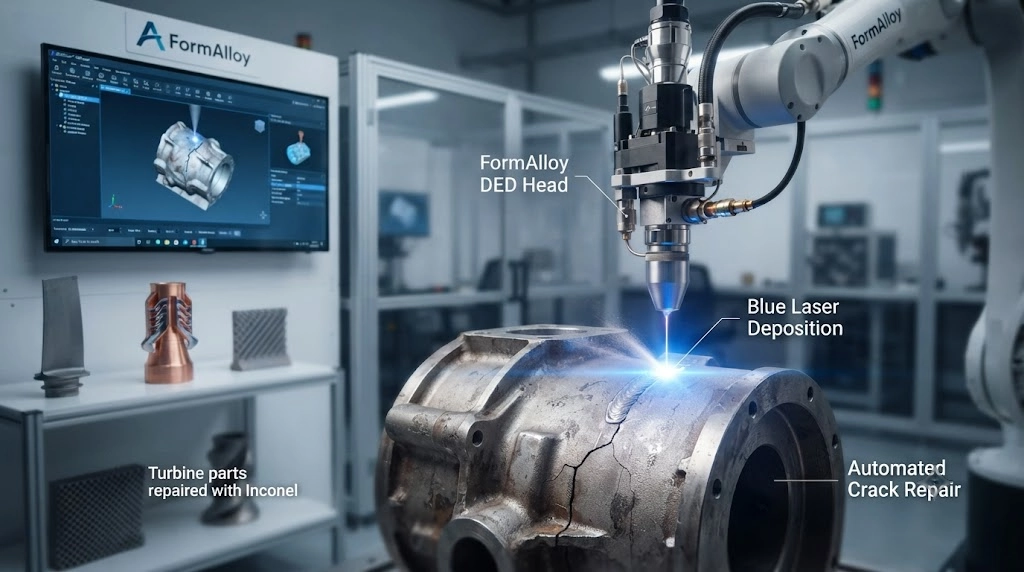
FormAlloy’s DEDSmart® repair capability automates the scan-to-print path for worn parts. The system scans the damaged component and generates the deposition path automatically. Human error in path planning is removed from the equation entirely.
How Laser Metal Deposition Compares to Other Repair and Coating Methods
Different processes suit different problems. This table shows where laser metal deposition stands compared to common alternatives.
| Process | Bond Type | Material Waste | Precision | Best For |
| Laser Metal Deposition | Metallurgical | Very Low | High | Repair, cladding, new parts |
| Thermal Spray | Mechanical | Moderate | Medium | Surface coatings only |
| TIG Welding | Fusion | Low | Low to Medium | Simple repairs |
| Plasma Spray | Mechanical | Moderate | Low | Thick coatings |
| Cold Spray | Mechanical | Low | Medium | Soft metals, coatings |
The key difference is bond type. Thermal spray and cold spray coatings attach mechanically. They can peel, crack, or delaminate under stress. Laser cladding creates a true metallurgical bond. The deposited material and the base part become one.
For parts operating under high stress, high temperature, or repeated loading cycles, that difference matters a great deal. Mechanical bonds fail. Metallurgical bonds hold.
FormAlloy’s services page covers the full range of applications where this bond quality makes the difference between a part that lasts and one that fails in service.
What Materials FormAlloy Processes with Laser Metal Deposition Services
Not every laser metal deposition system can handle every alloy. Some materials are reactive. Some absorb laser energy poorly. Some require precise thermal control to avoid cracking.
FormAlloy’s systems are built for the full range of engineering alloys used in demanding applications.
Common materials include:
- Titanium alloys including Ti-6Al-4V for aerospace and biomedical
- Nickel superalloys including Inconel 625 and 718 for high-temperature applications
- Stainless steels including 316L and 17-4 PH for corrosion-resistant structures
- Tool steels including H13 and M2 for die and mold repair
- Copper alloys including GRCop-42 for rocket thermal management
- Cobalt alloys including Stellite 6 for wear-resistant cladding
Copper is one of the hardest materials to process with standard lasers because it reflects infrared energy. FormAlloy solves this with a blue laser option (450nm wavelength), which copper absorbs far more efficiently. This is a capability most laser cladding services simply do not offer.
The DEDSmart® technology overview explains how variable wavelength laser options expand what is possible with difficult materials.
Where Laser Metal Additive Manufacturing Fits in Real Production Environments
Laser metal additive manufacturing is not a lab technology anymore. It runs in aerospace facilities, energy sector maintenance shops, and defense manufacturing plants every day.
Here is where it fits in real operations:
New part production. You have a CAD file. You need a complex metal geometry that machining cannot produce efficiently. Directed energy deposition builds it layer by layer with minimal material waste. Deposition rates reach up to 7kg per hour, making production-scale output realistic.
Surface protection. A pump housing operates in corrosive fluid. A drill bit works in abrasive rock. Depositing a wear-resistant alloy like Stellite 6 on the surface extends service life without replacing the whole component.
Alloy development. FormAlloy’s ADF system switches between up to 16 alloys in one build session. Materials engineers can screen new compositions quickly. What used to take months now happens in days.
NASA confirms DED is actively used across these applications for aerospace components, with multiple DED variants suited to different part sizes and alloys (NASA NTRS, 2021).
The FormAlloy insights page covers active case studies and new material developments.
Conclusion
Laser metal deposition services solve problems traditional manufacturing cannot. A cracked die does not have to be scrapped. A worn shaft does not have to be replaced. A geometry machining cannot be built in days.
FormAlloy’s directed energy deposition platform covers new part production, laser cladding services, repair, and alloy research in one place.
Frequently Asked Questions
Q: What is the difference between laser metal deposition and laser powder bed fusion?
Laser powder bed fusion builds parts inside a powder bed. Laser metal deposition sprays powder directly at a focused laser. DED handles larger parts and repair applications that powder bed systems cannot reach.
Q: Can laser metal deposition repair a cracked turbine blade?
Yes. The process deposits material directly onto damaged areas and bonds metallurgically to the base. Post-machining restores the geometry. This is far cheaper than scrapping and replacing a high-value aerospace component.
Q: What alloys can FormAlloy process with laser metal deposition?
FormAlloy processes titanium alloys, Inconel grades, stainless steels, tool steels, copper alloys, and cobalt alloys. The blue laser option extends capability to copper and other IR-reflective materials most systems cannot handle reliably.
Q: How thick can a laser cladding layer be in a single pass?
Layer thickness ranges from fractions of a millimeter up to several millimeters per pass depending on the application. Multiple passes build up thicker deposits. The system adjusts parameters to maintain density and bond quality throughout.
Q: Is laser metal deposition faster than traditional machining for complex parts?
For complex geometries in high-value alloys, yes. Machining removes most of the material you start with. DED builds up only what is needed, dramatically reducing material waste and cutting total production time on difficult geometries.
Q: What is the surface finish quality after laser metal deposition?
As-deposited surfaces are near-net-shape but typically require CNC post-machining for tight tolerances. The deposited material machines cleanly and behaves like wrought material in most cases, making post-processing straightforward.
Q: Can FormAlloy deposit two different materials in the same part?
Yes. The ADF Alloy Development Feeder switches between up to 16 alloy vials and creates functionally graded structures within a single build. No weld joint, no fasteners, just a smooth transition in composition.
Q: How does laser cladding compare to thermal spray for wear protection?
Laser cladding creates a metallurgical bond. Thermal spray creates a mechanical one. Under stress or thermal cycling, thermal spray coatings can delaminate. Laser cladding holds because the deposit becomes part of the base material.
Q: What industries use FormAlloy laser metal deposition services most often?
Aerospace, defense, oil and gas, power generation, and heavy equipment manufacturing are the primary sectors. Any industry with high-value metal components that wear, crack, or require protective coatings benefits from this service.
Key Takeaways
- Laser metal deposition services build new parts, repair damaged components, and apply wear-resistant coatings using a focused laser and metal powder with a true metallurgical bond.
- Laser cladding outperforms thermal spray for high-stress applications because the deposit bonds to the base material rather than sitting on top of it.
- FormAlloy’s blue laser option (450nm) extends directed energy deposition capability to copper and other IR-reflective alloys that standard systems cannot handle.
- Metal component repair using DED costs far less than replacement for high-value parts like turbine blades and dies, while restoring full structural integrity.