TL;DR
Conventional metal fabrication often suffers from heat warping, material scrap, and unpredictable quality issues that drive up production costs. Modern Directed Energy Deposition (DED) systems solve these challenges by delivering real-time process monitoring and precise thermal control. Upgrading to next-generation metallic technology allows manufacturers to produce, repair, and coat complex components up to 100 times faster.
What Causes Welding Distortion in Metal Fabrication?
Metal component production constantly battles heat-induced distortion. Standard metal joining methods subject parts to intense thermal cycles. These high thermal cycles distort fine geometries, create internal residual stress, and cause structural weaknesses. When parts warp, shop floors face expensive downtime, scrapped raw materials, and endless rework cycles. Traditional industrial joining approaches lack the real-time feedback required to control heat input at the microscopic level.
When a single batch of specialized alloys fails quality testing, production schedules collapse. High-performance sectors like aerospace and defense cannot risk using components with internal micro-cracks or loose dimensional tolerances. Outdated shop setups force operators to guess parameters, which creates inconsistent weld seams. Modern manufacturing demands precise metallic deposition processes that remove operator error and protect part integrity from start to finish.
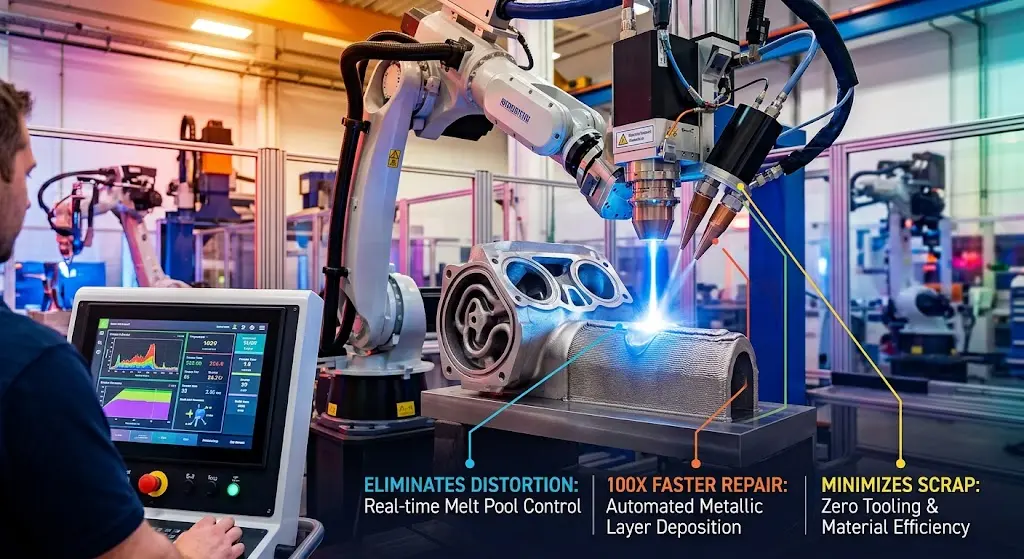
Deploying state-of-the-art welding systems provides the exact thermal control needed to stop part distortion. Modern hardware uses closed-loop monitoring to make split-second laser and power corrections. These continuous adjustments keep melt pools stable, protect base materials, and prevent thermal distortion. This high precision reduces post-processing work while ensuring every manufactured component meets strict industrial standards.
How Welding Automation Reduces Scrap and Downtime
Rising material costs and scarce skilled labor make physical scrap a critical business risk. Manual setups often lead to filler metal waste, incomplete penetration, and uneven joint fills. Advanced robotic welding systems combine multi-axis motion with automated powder or wire delivery. This setup places exact material quantities only where needed, reducing raw material consumption and clean-up time.
Automation extends equipment working life by enabling precise component repair. Instead of discarding worn engine components, turbomachinery parts, or stamping dies, operators can rebuild damaged areas with matching alloys. The automated toolhead deposits fully dense metal layers onto worn surfaces, restoring original dimensions while maintaining strong metallurgical bonds.
| Operational Metric | Legacy Welding Equipment | Modern Automated DED Systems |
| Material Utilization Rate | Low (High scrap from manual grinding) | High (Precision powder/wire targeting) |
| Deposition Speed | Standard baseline rate | Up to 2 to 100 times faster |
| Quality Control Method | Post-weld destructive testing | Real-time sensor-based monitoring |
| Thermal Distortion Risk | High (Uncontrolled heat exposure) | Extremely Low (Targeted energy focus) |
| Multi-Material Capability | Limited or impossible | Fully integrated alloy blending |
According to researchers at the National Institute of Standards and Technology, real-time sensor integration in automated cells helps catch weld defects 32 times per second. Catching defects instantly prevents full-part scrap and protects production yield.
Upgrading Capabilities With Multi-Material Laser Cladding
Industrial machinery usually fails from localized surface wear or high-temperature corrosion, rather than total structural failure. Building entire components out of expensive superalloys increases production costs. Integrating industrial welding systems with laser cladding technology lets engineers apply high-performance alloys directly to low-cost base metals.
This multi-material approach coats critical stress points with wear-resistant or heat-resistant alloys. By applying exotic alloys only where needed, manufacturers improve component durability while keeping material costs low.
The U.S. Department of Energy AMMTO highlights that additive manufacturing techniques help form near-net-shape components with significantly less energy and material waste. Combining laser cladding with structural metal deposition helps plants build custom surface properties that withstand harsh chemical and high-friction environments.
Streamlining Shop Floors with Flexible Robotic Integration
Modern manufacturing requires quick adjustments to changing project requirements. Fixed single-purpose machinery slows down shop productivity when switching between different part geometries. Versatile automated welding systems integrate with standard multi-axis robotic arms, turning standard work cells into flexible manufacturing stations.
Flexible motion platforms allow operators to alternate between component creation, surface cladding, and part repair within a single production cell. Combining multi-axis motion with dynamic parameter controls lets shops handle complex, non-linear geometries without expensive custom fixtures.
Using smart software automation removes manual guesswork. System controllers adjust laser focus, powder feed rates, and travel speeds in real time. This automated control maintains consistent bead height and smooth layer bonding across intricate metal surfaces.
Building Defense and Aerospace Components With Superior Alloy Quality
High-stress industries require fully dense metal structures with zero internal voids or inclusions. Traditional casting methods often suffer from internal porosity, long lead times, and high tooling costs. Utilizing robotic welding systems for metallic additive manufacturing bypasses traditional tooling, producing flight-ready parts faster than conventional foundries.
Advanced deposition technology processes demanding materials, including Nickel Superalloys (IN718, IN625), Cobalt-based alloys, Titanium, and highly conductive Copper combinations. Precise atmosphere management and targeted energy delivery produce refined grain structures that match or exceed forged metal properties.
Deploying modern, advanced welding equipment protects critical supply chains. Facilities can manufacture replacement parts on demand, reducing reliance on offshore suppliers and large spare-parts inventories. Shops achieve total process traceability by recording operational data for every layer deposited.
Enhancing Manufacturing Productivity Through Directed Energy Deposition
Integrating Directed Energy Deposition (DED) into existing production lines creates new opportunities for design optimization and rapid prototyping. Choosing welding automation systems built for additive metal manufacturing helps shops produce complex internal cooling channels and custom geometry features that standard subtractive tooling cannot execute.
Adopting advanced additive technology shortens product development cycles from months to days. Engineering teams can quickly print functional prototypes, test mechanical properties, and make CAD updates without waiting for new tooling or molds.
This design flexibility simplifies complex assemblies by combining multi-piece hardware into single, monolithic components. Reducing total part counts lowers assembly line labor, removes potential leak points, and simplifies supply chain logistics.
Modernizing Metal Fabrication Equipment to Protect Profitability
Outdated equipment creates unseen production bottlenecks, high energy bills, and excessive material waste. Modernizing facility equipment with multi-functional DED systems optimizes overall production workflow. Shops can shift effortlessly between 3D metal printing, surface modification, and structural repair using one unified hardware setup.
Investing in precise metal deposition technology stabilizes operational overhead. Automated process monitoring lowers labor costs by enabling semi-unattended manufacturing runs. Higher deposition efficiency reduces energy use per part, supporting cleaner, cost-effective factory operations.
Upgrading shop technology ensures long-term market competitiveness. Companies that adopt flexible, automated deposition systems deliver finished parts faster, maintain higher quality standards, and accept complex custom jobs that legacy facilities cannot process.
Frequently Asked Questions
What makes Directed Energy Deposition different from standard industrial welding processes?
Directed Energy Deposition uses targeted laser power and automated powder or wire feeds to build, clad, or repair metal components layer by layer with precise thermal management and real-time process control.
How do real-time monitoring sensors improve overall metallic part deposition quality?
Real-time monitoring sensors continuously evaluate the melt pool area and heat generation, instantly modifying operational settings to prevent internal micro-cracks, void formations, and part warping during deposition runs.
Can advanced additive systems process exotic superalloys like Nickel and Cobalt combinations?
Yes, modern systems efficiently process high-performance materials including Nickel Superalloys (IN718, IN625), Cobalt-based materials, Titanium, and conductive Copper alloys with high density and excellent mechanical strength.
How does multi-material cladding lower raw material costs for heavy industrial components?
Multi-material cladding applies expensive, wear-resistant superalloys only to critical surface contact areas, using lower-cost carbon or stainless steels for the remaining structural body of the component.
What industries gain the biggest performance advantages from automated metallic repair systems?
Aerospace, defense, power generation, oil and gas, and heavy automotive sectors gain major advantages by repairing valuable worn components instead of waiting for expensive replacement castings.
How does automated material deposition reduce total post-processing time for shop floors?
Automated systems control layer thickness and deposit profiles with extreme accuracy, creating near-net-shape components that need minimal surface grinding or finish machining before final installation.
Can custom 3D metallic printing replace traditional metal investment casting setups?
Yes, metal DED technology creates near-net-shape parts directly from CAD files without expensive molds, cutting lead times from several months down to just a few days.
What steps prevent oxidation defects when processing sensitive metals like Titanium?
Deposition systems use localized shielding gas controls or sealed inert gas chambers to keep oxygen levels extremely low, preventing surface contamination during high-temperature printing phases.
How do automated deposition cells integrate with existing factory floor systems?
Modern systems support standard industrial communications protocols, connecting directly with factory CAD software, multi-axis robotic arms, and central quality control databases for full operational integration.
What causes metal fabrication distortion during welding?
Metal fabrication distortion occurs when uneven heating and cooling cause metal to expand and contract. High heat input, uneven weld placement, poor joint design, and insufficient fixturing can contribute to warping and dimensional changes. Manufacturers can reduce these problems through controlled heat input, proper welding sequences, suitable fixtures, and consistent process parameters.
How can manufacturers reduce welding distortion?
Manufacturers can reduce welding distortion by controlling heat input, selecting suitable welding sequences, using proper fixtures, and monitoring process conditions. Automated welding systems can improve repeatability by maintaining consistent operating parameters. FormAlloy’s Directed Energy Deposition technology also supports controlled metal deposition for suitable repair, cladding, and manufacturing applications.
Can laser metal deposition reduce distortion in metal parts?
Laser metal deposition can reduce thermal distortion in certain applications by concentrating energy in a controlled deposition area. This makes it useful for repairing worn components, applying protective coatings, and adding material to existing parts. Results depend on the metal alloy, component geometry, heat input, deposition strategy, and cooling conditions. Additional finishing or heat treatment may still be necessary.
Crucial Takeaways for Plant Managers
- Thermal Control: Real-time sensor feedback eliminates thermal distortion and protects structural part tolerances.
- Cost Efficiency: Multi-material cladding applies high-performance superalloys only where wear resistance is necessary.
- Fast Repair: Automated deposition rebuilds damaged components up to 100 times faster than manual repair methods.
- Supply Resilience: On-demand metal printing removes long casting lead times and reduces reliance on external vendors.
Upgrade Your Production Operations Today
Obsolete metal joining processes do not have to drain your factory’s profitability or slow down project delivery schedules. Upgrade your manufacturing cell with industry-leading Directed Energy Deposition hardware built to solve your toughest production challenges. Partner with our team of additive manufacturing experts to streamline your fabrication processes, minimize material waste, and achieve superior part quality. Contact us today to request a custom performance evaluation for your manufacturing facility.