Let’s be honest. Most manufacturers don’t have time for debates that don’t directly affect their bottom line. But the conversation around robotic welding vs manual welding is one you genuinely can’t afford to ignore.
Here’s a simple way to picture it. Imagine a mid-sized fabrication shop running three manual welders on a single shift. According to the U.S. Bureau of Labor Statistics, the median annual wage for a welder is around $51,000. Factor in benefits and employer overhead, and that number jumps to roughly $67,800 per welder, per year. That’s over $200,000 annually in labor alone, before you even count rework, material waste, or unplanned absences.
Every hour your team spends on the wrong method is money quietly walking out the door. Whether you’re scaling up production or trying to hit tighter tolerances without blowing your budget, the choice between these two approaches carries very real financial consequences.
So what actually matters for your operation?
What Are We Actually Comparing Here?
Think of it this way. Imagine two chefs in a kitchen. One is a seasoned professional who has spent 20 years perfecting every cut and every flame by feel and instinct. The other is a high-tech cooking machine that was programmed to replicate that chef’s best dish, perfectly, every single time, without ever needing a coffee break.
That’s basically robotic welding vs manual welding in a nutshell. But before we get into the numbers and the tradeoffs, let’s make sure we’re on the same page about what each one actually is.
What Is Robotic Welding?
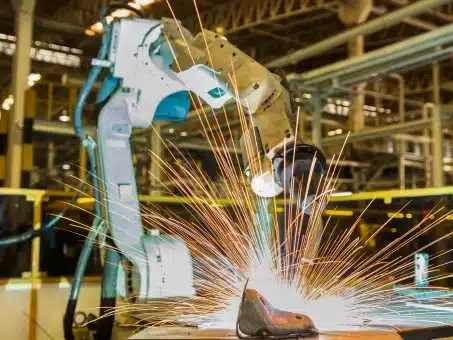
Robotic welding is an automated process where a programmable robotic arm controls a welding torch and follows a set path to fuse metal parts. Once it’s programmed, it runs. The system uses a multi-axis robotic arm, a controller unit, a welding power supply, and sensors that work together to deliver precise, repeatable welds along a predefined path.
No fatigue. No bad days. No variation. Just the same clean, consistent weld, thousands of times over.
What Is Manual Welding?
Manual welding, on the other hand, is exactly what it sounds like. A trained human welder uses their hands, eyes, and years of hard-won skill to join metal pieces together. It’s flexible, adaptable, and deeply dependent on the individual doing the work. A great welder is genuinely impressive to watch.
The problem? Great welders are getting harder and harder to find.
What Are the Real Tradeoffs?
The advantages and disadvantages of robotic welding over manual welding do exist, and pretending otherwise wouldn’t serve you. Robotic systems require upfront investment, programming time, and skilled technicians to set them up right. For very small batch sizes or highly irregular jobs, that setup cost can feel hard to justify in the short term.
But once you’re past that initial curve, the advantages compound quickly. Faster cycle times, dramatically lower rework rates, consistent quality at scale, and a production line that doesn’t depend on whether your best welder showed up today. For manufacturers operating in precision-driven industries like aerospace or industrial equipment, robotic welding vs manual welding stops being a close comparison very quickly. Automation wins, and the data backs that up. We’ll show you exactly how in the sections ahead.
Robotic Welding Applications in Industry
Picture a car rolling off an assembly line. Every door panel, every chassis joint, every structural seam has been welded with pinpoint accuracy, thousands of times over, without a single inconsistency. Behind that? A robotic welding system that never blinks, never tires, and never has an off Friday afternoon.
This isn’t a glimpse into the future. It’s already the standard across some of the most demanding industries on the planet. And when you look at where robotic welding vs manual welding decisions are being made today, the pattern becomes very clear. Automation is winning, and it’s winning by a wide margin.
Automotive
The automotive and transportation sector contributes 44.4% of the global robotic welding market share in 2024, driven by the demand for flexible manufacturing processes, tight production tolerances, and the ability to switch seamlessly between different welding types on the same line.
Think about what that means in practical terms. Every time a new vehicle model rolls out, a robotic welding system can be reprogrammed to handle the updated design. No retraining. No months of adjustment. Just updated the code for a faster ramp-up. A human welder, no matter how skilled, simply cannot match that kind of adaptability at volume.
Aerospace and Defense
If automotive is where robotic welding proved itself, aerospace is where it earned its reputation for excellence. When you’re welding components that will operate at 35,000 feet or in a defense application where failure is not an option, there is zero room for human error.
That level of consistency is simply not achievable by hand, no matter how experienced the welder. This is exactly the kind of environment where knowing when to use robotic welding instead of manual welding stops being a strategic question and becomes an obvious answer.
Heavy Equipment and Industrial Manufacturing
Beyond aerospace and automotive, robotic welding has become the backbone of heavy equipment manufacturing. Think excavators, industrial turbines, and large-scale structural steel components. These are jobs that require massive throughput and absolutely cannot afford rework.
By the end of 2023, the global operational stock of welding robots reached approximately 4.28 million units, with more than 71,000 new welding robots installed in 2024 alone, with the metals and machinery sector absorbing around 11,000 of those units.
That’s not a trend. That’s a structural shift in how industrial manufacturing gets done.
Frequently Asked Questions
Q: What is the main difference between robotic welding and manual welding?
The core difference comes down to who or what is doing the work. Robotic welding uses a programmed automated arm to deliver consistent, repeatable welds at high speed, while manual welding relies on a skilled human operator. For high-volume, precision-driven production, robotic systems consistently outperform their manual counterparts.
Q: Is robotic welding more expensive than manual welding upfront?
Yes, the initial setup cost for a robotic welding system is higher than hiring a manual welder. However, when you factor in labor costs, rework, and productivity gains over time, robotic welding is a smarter long-term investment.
Q: What are the biggest robotic welding advantages in manufacturing?
The three biggest advantages are speed, consistency, and cost efficiency at scale. Robotic systems can run double shifts without fatigue, deliver the same weld quality thousands of times over, and significantly reduce the rework and material waste that drives up costs in manual operations.
Q: Are there situations where manual welding is still the better choice?
Manual welding can make sense for very low-volume, one-off jobs or highly irregular geometries that would require significant reprogramming time for a robotic system. That said, as production volume increases and tolerances tighten, the case for manual welding vs robot welding shifts decisively in favor of automation.
Q: What industries use robotic welding the most?
Robotic welding applications in industry are most prominent in automotive, aerospace, defense, and heavy equipment manufacturing. These sectors demand high throughput, tight tolerances, and consistent quality at a scale that simply cannot be achieved by manual labor alone.
How FormAlloy Is Transforming the Industry
At FormAlloy, we don’t just believe automation is the future of metal manufacturing. We’re actively building it. Our DEDSmart® Directed Energy Deposition technology takes everything that makes robotic welding advantages in manufacturing so compelling and pushes it several steps further.
If you’re ready to stop asking which welding method costs less and start asking what your manufacturing operation is truly capable of, we’d love to show you. Explore our DEDSmart® solutions at formalloy.com or reach out to our team directly to talk through what’s possible for your specific application.
The next generation of metal manufacturing isn’t coming. It’s already here. Let’s build something better, together.
Contact FormAlloy today to learn more.