TL;DR
Traditional metal forging often leads to high costs, long wait times, and sudden supply chain failures. High precision 3d printed metal parts solve these big problems by providing fast, strong, and flexible custom metal components. Modern additive manufacturing lets you build complex metal structures on demand without costly tooling.
The Big Pain Point in Old Metal Manufacturing
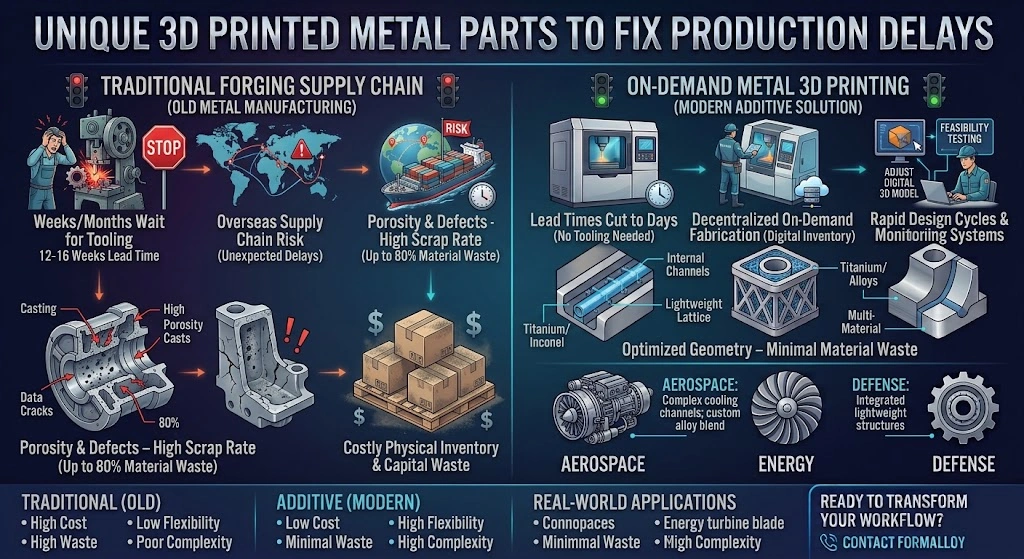
Traditional metal manufacturing is breaking down for many modern companies. Relying on old casting or CNC machining methods often means waiting weeks or months for basic tooling. When a critical machine part wears down, whole assembly lines stop. This unexpected downtime costs thousands of dollars every hour.
Finding custom parts for small production runs is very hard today. Traditional factories often reject small custom orders or charge giant upfront tooling fees. Buying extra replacement parts to store in warehouses wastes capital. Supply chains are unpredictable, so waiting for overseas metal shipments adds risk to your business.
Modern businesses need a faster way to make strong components. At FormAlloy, utilizing high-performance 3D printed metal parts removes these painful bottlenecks. Advanced additive technology builds parts layer by layer directly from CAD files. This approach cuts lead times from months to days, letting you make custom parts when you need them.
How the Metal 3D Printing Process Fixes Supply Chain Bottlenecks
The modern metal 3D printing process changes how engineers design and make high-strength components. Old subtractive methods carve away expensive metal, which wastes raw materials. Directed energy deposition and powder bed methods fuse metal powders using focused laser beams. This builds dense metal structures with very little waste.
This layer-by-layer build process eliminates the need for expensive fixed dies or molds. If a design needs an update, engineers adjust the digital 3D model instead of building brand-new physical tools. This digital approach speeds up testing cycles and lets teams fix design issues quickly.
Laser-based systems give you precise heat control during the build. Real-time monitoring systems track the melt pool to protect against hidden internal flaws. These process controls make sure every finished component matches strict structural standards.
Research from the National Institute of Standards and Technology shows how additive systems shorten design cycles while keeping strong mechanical properties.
Creating Strong Custom Metal 3D Printed Parts for Tough Work
Every industrial application faces unique stresses, high heat, or corrosive chemicals. Standard off-the-shelf catalog parts often fail early in tough working environments. Creating custom metal 3D printed parts lets engineers tailor component geometry to exact working conditions.
Additive builds allow for internal cooling channels, lightweight lattice structures, and variable wall thicknesses. These custom geometry features are impossible to make with traditional drill bits or CNC end mills. You can also join two distinct metal alloys into a single seamless component. Placing wear-resistant alloys on the surface while keeping a ductile metal core extends total part life.
| Feature Comparison | Traditional Metal Machining | Advanced Metal 3D Printing |
| Tooling Lead Time | 6 to 16 Weeks | Zero Tooling Needed |
| Material Waste | Up to 80% Scrap Metal | Very Low Waste |
| Complex Geometries | Very Limited or Impossible | Built-In Internal Channels |
| Multi-Material Builds | Requires Manual Assembly | Seamless Single-Build Joining |
| Small Batch Cost | Very High Tooling Expense | Cost-Effective On-Demand |
Custom builds let you combine multi-piece assemblies into a single printed structure. Reducing assembly steps removes failure points like bolts, gaskets, or welds. This results in stronger, lighter, and more reliable machine hardware.
To explore options for customized material combinations and specialized parameters, read through our Parameter Development options.
Main Industrial Metal 3D Printing Upgrades for Modern Production
Adopting industrial metal 3D printing gives production teams a distinct operational edge. Rather than replacing entire damaged machines, engineers use targeted laser cladding to repair worn surfaces. Restoring worn areas with fresh metal alloys extends equipment operational life at a fraction of full replacement cost.
High-tier industrial systems process demanding materials like Inconel, Titanium, and Copper alloys. These metals resist extreme heat and chemical exposure, making them ideal for defense, aerospace, and heavy industry. Industrial printers run continuous deposition cycles to support consistent batch production.
For complete technical specifications on hardware configurations, review our X-Series & L-Series Systems details.
If you need fast feasibility verification before scaling up, check our Feasibility Testing offerings.
Smart Quality Controls for Advanced 3d Printed Metal Parts
Maintaining strict structural quality is essential when printing critical factory hardware. Modern additive systems rely on closed-loop feedback systems to inspect the build during production. Thermal cameras and optical sensors measure the laser melt pool thousands of times per second. If small thermal changes occur, the system automatically adjusts laser power or motion speed.
This live monitoring ensures consistent layer density and eliminates porosity issues early. Real-time quality verification gives engineering teams complete confidence in every finished build. This automated process validation reduces the need for expensive post-build destructive testing steps.
Major Benefits of Metal 3D Printing for Modern Factories
The financial and operational benefits of metal 3D printing go far beyond simple fast prototyping. Factories can transition from large, risky physical inventories to digital part catalogs. Storing CAD files in the cloud lets you print replacement hardware right when a line goes down.
Key benefits include:
- Fast Lead Times: Cut production delays from months down to a few days.
- Lower Material Scrap: Melt only the exact amount of alloy powder needed for the build.
- Better Part Performance: Design complex internal cooling paths that reduce thermal strain.
- Simplified Assemblies: Combine multi-part items into single unified components.
- Cost-Effective Repairs: Restore expensive, worn tooling instead of throwing it away.
According to technical research by NASA Technology, automated additive workflows greatly reduce human labor while improving component turnaround speed.
To see how advanced deposition heads upgrade your current setup, view our AX Metal Deposition Head hardware.
Real-World Applications of Metal 3D-Printed Parts
The versatility of modern additive machinery makes it vital across demanding commercial sectors. From high-altitude flight to ground energy plants, additive metal solutions fix hard manufacturing problems daily.
- Aerospace & Rocketry: Rocket engines require complex cooling channels to survive burning fuel. Additive laser builds form curved internal liquid channels inside single-piece copper nozzles.
- Energy & Power Generation: Heavy turbine blades face constant erosion. Laser cladding adds tough Stellite coatings onto blade edges to prevent early corrosion.
- Automotive & Defense: Custom drive shafts and specialized helical pinions require high strength-to-weight ratios. Additive printing builds light, high-strength parts quickly.
To discover how custom multi-alloy builds extend component life, read our Custom Material Systems guide.
Key Takeaways
- 3d printed metal parts solve traditional supply chain delays by offering fast, on-demand component fabrication.
- The modern metal 3D printing process eliminates fixed tooling costs while producing dense, highly accurate metal components.
- Designing custom metal 3D-printed parts lets engineers combine multiple pieces into a single, lightweight build.
- Utilizing industrial metal 3D printing allows factories to repair valuable worn parts instead of purchasing costly replacements.
- Realizing the benefits of metal 3D printing helps companies lower material waste and modernize digital inventory management.
- Key applications of metal 3D printed parts span aerospace, defense, energy, and heavy manufacturing.
Smart Frequently Asked Questions
What are 3d printed metal parts?
They are high-density metal components created by melting metal powders or wires with a laser, layer by layer, directly from digital CAD files.
How does the metal 3D printing process work?
The machine uses a focused laser beam to deposit and melt metal powder or wire layer by layer into a solid structural part.
What are custom metal 3D-printed parts used for?
Engineers use them for complex designs, internal cooling channels, fast prototypes, and custom alloy combinations across demanding industrial applications.
Why choose industrial metal 3D printing over CNC machining?
Additive manufacturing reduces material scrap, eliminates costly tooling wait times, and creates intricate shapes that traditional drill bits cannot cut.
What are the main benefits of metal 3D printing?
It speeds up production, lowers scrap material waste, enables complex part consolidation, and allows direct repair of valuable worn components.
What are common applications of metal 3D-printed parts?
Common uses include rocket nozzles, turbine repair, custom heat exchangers, specialized gears, and wear-resistant coatings for heavy machinery.
Are 3D-printed metal parts as strong as forged parts?
Yes, modern directed energy deposition produces fully dense, metallurgically bonded parts with mechanical properties equal to or exceeding standard forged metals.
Can you repair existing metal components with 3D printing?
Yes, laser cladding adds new metal layers onto worn or damaged components, restoring them to full operational standards quickly.
Which metals can be used in additive manufacturing?
Popular options include Stainless Steel, Inconel, Titanium, Copper, Cobalt-Chrome, and specialized custom alloy combinations.
Ready to Transform Your Metal Production Workflow?
Do not let long supplier delays and high tooling fees hold back your manufacturing. Our team provides advanced additive technology to help you build, repair, and upgrade critical metal hardware quickly. Contact FormAlloy Today to discuss your custom project needs.