TL;DR
Long production cycles and high material waste often slow down aerospace supply chains. At FormAlloy, advanced metal additive processes solve these delays by building strong metal parts faster and with less waste. This guide shows how modern deposition technology cuts lead times, restores worn flight hardware, and lowers material costs for flight critical applications.
What Is Modern Aerospace Component Manufacturing?
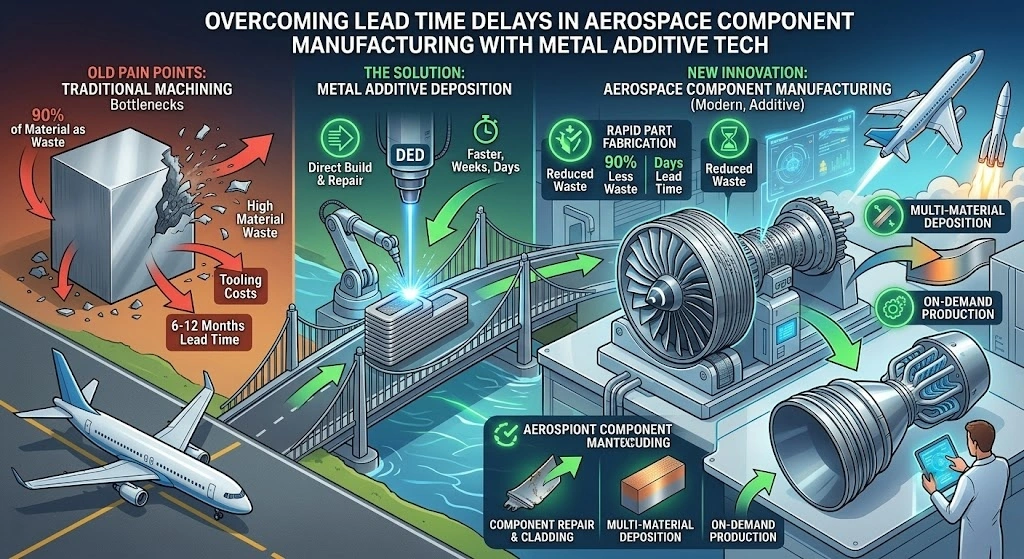
Aerospace Component Manufacturing is the process of creating metal parts built to withstand extreme temperatures, severe pressure, and intense structural stress. Traditional machining creates these parts by taking a solid block of metal and carving away material until the final shape remains. This old method wastes up to 90 percent of expensive raw metals like nickel superalloys and titanium. It also forces engineering teams to wait six to twelve months for custom forged blocks to arrive at the factory floor.
Modern flight programs cannot afford those long delays. Today, high-performance Aerospace Parts Manufacturing relies on advanced additive technology like Directed Energy Deposition, also known as DED. DED feeds metal powder or wire directly into a focused laser beam to melt and build parts layer by layer. Instead of cutting away metal, additive systems add material only where it is needed.
By switching to metal 3D deposition, companies reduce lead times from months down to days. They can also repair worn flight hardware instead of scrapping expensive assemblies. Research highlighted in the NASA Rocket Engine Additive Manufacturing Study shows that additive methods safely produce combustion chamber parts that pass high-pressure hot-fire tests while dramatically lowering build time.
Why Traditional Aerospace Parts Manufacturing Creates Costly Bottlenecks
Building parts for aircraft and spacecraft requires materials that resist heat and corrosion. Inconel, cobalt-chrome, and titanium are perfect for extreme environments, but they are very hard to cut using standard CNC tools. Traditional machining wears out cutting bits quickly, slows production speeds, and generates mountains of scrapped metal dust.
Another major headache is tooling. Traditional forging needs custom dies and molds that take months to design and build. If an engineering team makes a small design change, the entire tooling process must start over from zero. This creates huge financial risks and keeps new aircraft designs stuck on the drawing board.
These delays harm every layer of the flight industry. When critical replacement parts are stuck in a months-long manufacturing queue, aircraft stay grounded on the tarmac. Commercial airlines lose revenue every hour an airplane sits idle, while defense contractors face strict deadline penalties.
To break free from these supply chain bottlenecks, major companies now use specialized Metal 3D Printing Services to build or repair flight parts on demand. Depositing metal directly onto a substrate removes the need for expensive custom tooling and cuts raw material costs by a wide margin.
How Advanced Aerospace Manufacturing Services Speed Up Production
Modern Aerospace Manufacturing Services use laser deposition systems to transform how engineers design, repair, and upgrade metal hardware. DED equipment mounts a deposition head on a multi-axis robotic arm or a CNC gantry. This allows the system to build complex shapes from any angle.
Here are the main ways advanced metal deposition solves critical manufacturing challenges:
- Rapid Part Fabrication: DED deposits metal at high rates, forming near-net-shape components in hours instead of weeks.
- Component Repair and Cladding: Damaged turbine blades, worn valves, and cracked engine casings do not need to be thrown away. DED lays down fresh metal over worn surfaces, restoring parts to original design specs.
- Multi-Material Deposition: DED systems can spray different alloy powders into the same melt pool. This creates bimetallic components that combine light weight with high heat resistance in a single seamless part.
- On-Demand Production: Defense bases and maintenance hubs can print replacement parts on site, eliminating long shipping delays and reducing warehouse inventory costs.
Government agencies continuously test these additive processes to set clear quality standards. According to the NIST Additive Manufacturing Research Program, real-time monitoring and material measurements during build cycles ensure that printed metal parts achieve the exact grain structure and fatigue strength needed for aerospace applications.
Key Applications of Precision Aerospace Components in Modern Flight
High-precision additive technology plays a role in almost every section of modern aerospace engineering. From commercial jet engines to satellite propulsion systems, laser deposition delivers lighter and stronger metal components.
Engineers can explore specialized Aerospace Metal Additive Applications to see how DED technology solves real flight challenges across different vehicles:
- Rocket Nozzles and Combustion Chambers: DED builds internal cooling channels directly inside rocket nozzles, preventing engine overheating during launch.
- Turbine Engine Components: Stator vanes, seal rings, and compressor blading benefit from wear-resistant coatings applied through high-speed deposition.
- Structural Airframe Brackets: Aircraft bodies require high strength-to-weight ratios. DED builds optimized structural mounts using high-grade titanium.
- Landing Gear Hardware: High-impact structural parts receive hard-facing alloy coatings that protect against friction, corrosion, and gravel damage during landing.
To meet strict flight standards, companies rely on custom Directed Energy Deposition Technology that offers precise temperature management and closed-loop feedback during every build step.
Comparing Aerospace Component Manufacturing Methods
The table below shows how traditional subtractive manufacturing compares directly against modern laser additive deposition across key production metrics.
| Performance Metric | Traditional CNC Machining | Forging and Casting | Directed Energy Deposition (DED) |
| Average Lead Time | 4 to 8 Weeks | 6 to 12 Months | 2 to 7 Days |
| Material Scrap Rate | Up to 90 Percent Waste | Moderate Waste | Under 10 Percent Waste |
| Tooling Cost | High (Cutting Bits) | Very High (Custom Dies) | None Required |
| Repair Capability | None (Scrap Only) | None (Scrap Only) | Excellent (Direct Cladding) |
| Multi-Material Capability | Impossible | Limited | Fully Supported |
| Design Flexibility | Restricted by Tool Angles | Restricted by Mold Removal | Complete Design Freedom |
By comparing these metrics, engineers can easily see why high-volume and high-value aerospace programs are moving away from traditional subtractive methods.
The Unique Benefits of Aerospace 3D Printing for Next-Gen Flight
Adopting Aerospace 3D Printing gives aerospace manufacturers a major advantage in quality, speed, and cost control. Modern aircraft demand lighter components to save fuel and lower carbon emissions. Additive manufacturing allows engineers to create internal hollow channels and lattice structures that subtractive tools cannot cut.
Using advanced Metal Additive Manufacturing Equipment, companies can build Precision Aerospace Components with minimal post-processing. Modern DED systems use dynamic beam lasers that adjust beam shape and energy density in real time. This keeps thermal distortion low, preventing warpage in thin-walled rocket nozzles and delicate engine shrouds.
Additive deposition also simplifies material testing and custom alloy creation. Companies working on experimental propulsion systems use Custom Alloy Development to blend unique metallic powders during the deposition build. This helps research teams develop brand-new superalloys that withstand temperatures far beyond what standard metals can handle.
When manufacturers need complex Aircraft Component Manufacturing, metal deposition simplifies multi-part assemblies into single integrated components. Combining ten separate fast-wearing parts into one solid printed piece eliminates leak points, reduces weight, and removes assembly labor completely.
Smart Solutions for Aerospace Production Challenges
The aerospace supply chain is evolving rapidly. Companies that rely only on traditional forging and subtractive machining risk falling behind as production schedules grow tighter. Modern laser deposition technology gives manufacturers the power to build complex parts quickly, restore damaged hardware, and lower material waste.
By integrating flexible Directed Energy Deposition into existing production lines, aerospace teams can produce high-strength metal components that meet strict flight standards while cutting lead times from months down to days.
Frequently Asked Questions
What is Directed Energy Deposition in aerospace manufacturing?
Directed Energy Deposition is an additive process that uses a focused laser to melt metal powder or wire as it deposits onto a surface, creating or repairing complex flight parts rapidly.
How does metal 3D printing reduce aerospace lead times?
Metal 3D printing builds parts layer by layer without needing custom molds or forged blocks, reducing component production times from several months down to just a few days or weeks.
Can worn or damaged jet engine parts be repaired with DED?
Yes, DED deposits fresh metal powder directly onto worn surfaces, rebuilding damaged turbine blades and engine casings back to original factory specifications without replacing the entire part.
What metal alloys are used in additive aerospace manufacturing?
Common materials include nickel superalloys like Inconel, high-strength titanium, cobalt-chrome, stainless steel, and custom bimetallic powder blends designed to withstand extreme flight heat and pressure.
How does additive deposition reduce material waste in aerospace production?
Traditional machining carves away up to 90 percent of a metal block, while additive deposition places metal only where needed, keeping raw material waste under ten percent.
Are 3D printed aerospace components safe for flight?
Yes, additive metal components undergo rigorous non-destructive testing, heat treatment, and quality inspections to ensure they meet or exceed all federal flight safety and performance standards.
What is the difference between DED and Powder Bed Fusion?
DED feeds metal powder or wire into a melt pool on open multi-axis systems, making it ideal for large parts and repairs, while Powder Bed Fusion builds small parts inside a powder box.
How does multi-material metal deposition work?
DED systems feed multiple metal powders into a single laser melt pool simultaneously, allowing engineers to create gradient alloys and bimetallic parts with combined heat and strength properties.
Why is dynamic beam shaping important in metal laser deposition?
Dynamic beam shaping adjusts the laser beam size and heat profile during deposition, preventing thermal stress, reducing part distortion, and ensuring consistent metal density throughout the build.
Key Takeaways
- Massive Time Savings: Advanced metal deposition cuts component lead times from six months down to a few days.
- Significant Waste Reduction: Additive processes cut raw material waste from 90 percent down to less than 10 percent.
- Cost-Effective Part Repair: Direct cladding restores worn engine parts instead of throwing away expensive assemblies.
- Design and Alloy Freedom: Multi-axis deposition allows multi-material builds, custom superalloys, and complex geometries.
Ready to Upgrade Your Aerospace Manufacturing Operations?
Stop letting long lead times, high material costs, and tooling delays slow down your flight hardware production. Discover how high-precision metal deposition systems and custom additive solutions can streamline your manufacturing workflow, repair critical components, and bring your next-generation aerospace designs to life. Contact our team of additive manufacturing experts today to discuss your exact project specs and request a detailed engineering consultation!